













Two frameworks govern tobacco website privacy in Australia: the Privacy Act 1988 with its Australian Privacy Principles, and the Public Health (Tobacco and Other Products) Act 2023. The Privacy Act covers how a business collects, stores and discloses your personal information. The Tobacco Act governs what can be advertised and sold online, and in some states, whether online sale is even permitted. If you run a tobacco website, publish an APP-aligned privacy policy and check your state’s advertising rules. If you’re buying, read the privacy policy, confirm delivery handling, and check your state’s rules before you order.
TL;DR:
- Most tobacco websites must publish a clear, layered privacy policy that details data collection, storage, and sharing practices, especially for payment and age verification data.
- Disclosing every tracking pixel and third-party data recipient in the privacy policy is essential, as un disclosed pixels may be considered unfair under Australian law.
- Online tobacco advertising is heavily restricted, and signs like lifestyle imagery or discount promotions can breach legal limits regardless of compliance with national or state regulations.
- Handling of personal data must follow the Notifiable Data Breaches scheme, requiring prompt notification to affected individuals and authorities if a serious breach occurs.
- Retailers like Cigarette Central specifically highlight secure payment processing, discreet packaging, and transparent privacy practices, making them more trustworthy choices for privacy-conscious buyers.
Table of Contents
- Which legal frameworks govern tobacco website privacy in Australia
- What the APPs require of a tobacco website privacy policy
- Tracking pixels, cookies and analytics: disclosure and fairness
- Data breaches and the Notifiable Data Breaches scheme
- Online tobacco advertising, point-of-sale rules and buying online in Australia
- Practical checklist for tobacco websites and for privacy-conscious shoppers
- Cigarette Central: what it offers and where privacy information lives
- How Cigarette Central product pages treat privacy: what to check
- Specific privacy considerations for minors accessing tobacco websites
- Guidance on data minimisation and retention practices for tobacco websites
- Editorial perspective: balancing privacy, compliance and shopper discretion
- Shopping with privacy in mind at Cigarette Central
- Sources
- FAQ
Which legal frameworks govern tobacco website privacy in Australia
The Privacy Act 1988 applies to most businesses with an annual turnover above $3 million, though smaller tobacco retailers can still be caught by exceptions for health information handling or third-party data trading. If your website is an APP entity, Australian Privacy Principle 1 requires a clearly expressed privacy policy, published free of charge.
Running alongside this is the Public Health (Tobacco and Other Products) Act 2023, which consolidated Commonwealth tobacco controls and commenced on 1 April 2024. It governs advertising, packaging and online point-of-sale content, separate from anything to do with personal data.
The two frameworks solve different problems:
- The Privacy Act asks: what happens to a customer’s name, address and payment details once they hit “checkout”?
- The Tobacco Act asks: can this product be shown, described or promoted online at all, and under what conditions?
A retailer can be fully compliant on data handling and still breach advertising rules, or vice versa. Treat them as two separate compliance jobs, not one.
What the APPs require of a tobacco website privacy policy
APP 1.3 to 1.5 set out the minimum content for a privacy policy, and the OAIC’s quick reference guide translates cleanly into what a tobacco retailer’s checkout flow should disclose:
- What’s collected — name, delivery address, date of birth for age verification, payment tokens, browsing behaviour.
- How it’s collected and held — directly at checkout, through age-gate prompts, or via analytics tools, and where it’s stored.
- Why it’s collected — order fulfilment, fraud prevention, marketing communications if opted in.
- Who it’s disclosed to — couriers, payment processors, and any overseas-based service providers.
- How customers can access or correct their information — and how to lodge a complaint if something goes wrong.
The OAIC’s guide to developing an APP privacy policy recommends a layered approach: a short, plain-English summary at the top, with the full policy available as a downloadable document underneath.
Pro Tip: Look for a line that says something like “we do not store your full card number; our payment processor holds that data under its own policy.” That single sentence tells you more about a retailer’s actual data practices than a page of generic security jargon.
Tracking pixels, cookies and analytics: disclosure and fairness
Tracking pixels aren’t banned. The OAIC’s guidance from November 2024 makes clear that pixels themselves are lawful tools, but collecting data through them without telling anyone is likely to be judged unfair.
For a tobacco website, that means:
- Mapping every tracking tag on the site, including retargeting pixels from ad platforms.
- Naming those tools and their purposes in the privacy policy, not just a vague “we use cookies” line.
- Doing basic due diligence on third-party vendors before installing their code.
- Treating retargeting and remarketing pixels as a form of direct marketing, which brings APP 7 limits on unsolicited contact into play.
If a site’s cookie banner says “we use cookies to improve your experience” and nothing else, that’s a gap worth noticing.
Data breaches and the Notifiable Data Breaches scheme
An incident becomes an “eligible data breach” when unauthorised access, disclosure or loss of personal information is likely to cause serious harm. Under the Notifiable Data Breaches scheme, entities must notify affected individuals and the OAIC once that threshold is met, and they must assess suspected breaches promptly.
By the numbers: the NDB scheme requires notification “as soon as practicable” once an entity is aware a breach is eligible. There’s no fixed day count in the legislation, but delay itself can become part of the harm assessment.
Operators should:
- Contain the breach and assess scope immediately.
- Notify affected customers with what was exposed, when, and what steps they’re taking.
- Report to the OAIC where the serious harm threshold is met.
If you receive a breach notice from a tobacco retailer, check exactly which fields were exposed. Payment tokens are less concerning than full card numbers or passwords. Change reused passwords, watch your bank statements for a few weeks, and contact your card issuer if payment data was involved.
Online tobacco advertising, point-of-sale rules and buying online in Australia
Whether a tobacco website can legally advertise its products, and whether you can legally buy from it, are two different questions with two different answers depending on where you live.
The Department of Health’s guide to online point-of-sale advertising requirements sets out what’s permitted: basic product listings with mandated warnings and age gates, generally without lifestyle imagery, discount language pitched as promotion, and social media integration that amplifies the product beyond a simple transaction.
State and territory law can override the Commonwealth position entirely. Some jurisdictions restrict or prohibit online tobacco sales outright, so a retailer being compliant nationally doesn’t guarantee it can legally ship to your address.
Watch for these signs a page has crossed from transaction into unlawful advertising:
- “Buy 2, get 1 free” style discount framing.
- Lifestyle photography or influencer-style content around the product.
- Prominent social sharing buttons on product pages.
Practical checklist for tobacco websites and for privacy-conscious shoppers
If you run a tobacco website, work through this before you go live or renew your compliance review:
- Publish a layered privacy policy: plain-English summary plus full APP document.
- Map every data flow from browsing through to dispatch notifications and support tickets.
- Name overseas recipients of personal data explicitly, including cloud hosting and payment gateways.
- Disclose every tracking pixel and its purpose.
- Document how long you retain customer data and why.
- Build an incident response process aligned with the NDB scheme, including who assesses, who notifies, and within what timeframe.
- Confirm your age-gating and jurisdiction filters actually block unlawful sales, not just display a warning.
Pro Tip: If you’re shopping and can’t find a privacy policy link in the footer within ten seconds, that’s a warning sign worth acting on. Reputable retailers make it easy to find, not buried three clicks deep.
Shoppers should check the policy names a payment processor, confirms delivery details aren’t shared beyond the courier, and states a retention period rather than “as long as necessary.” If none of that’s visible, ask support directly, or shop elsewhere.
Cigarette Central: what it offers and where privacy information lives
Cigarette Central offers services including shipping, packaging, payment processing, and customer support for Australian smokers buying tobacco products online. These are the retailer’s own stated features. Its site privacy policy and product pages are where delivery handling, payment processing and data retention details are commonly disclosed, and that’s the first place to check before ordering.
How Cigarette Central product pages treat privacy: what to check
Product listings vary in how much privacy-relevant detail they surface, and it’s worth comparing across a catalogue rather than assuming every page discloses the same thing.
- Premium Loose Tobacco 500g — Rich Blend, smooth rolling tobacco with fast shipping to your door; best suited to shoppers wanting a bulk loose-tobacco option with delivery details up front.
- Mevius Premium Light Charcoal No.8 — 20s x 10 packs with a smooth charcoal filter, fast delivery Australia-wide; a solid pick if you want carton-level quantity with clear dispatch timing.
- Esse Light Super Slim — 20s x 10 packs, smooth mild Korean ultra-slim style; suited to shoppers after a lighter cigarette with the same delivery and payment handling as the rest of the catalogue.
Across the range, look at how each listing describes shipping timeframes and packaging discretion. Consistency between product pages and the site’s overall privacy policy is a good sign; a listing that promises something the policy doesn’t mention is worth querying with support first. For a broader view of how delivery windows and courier handling work across the site, the tobacco delivery options guide breaks down last-mile practices in more depth.
Specific privacy considerations for minors accessing tobacco websites
Age verification sits at the intersection of both frameworks covered earlier, and it’s where a lot of tobacco websites get the balance wrong. The Tobacco Act requires age gates before product content is shown, but the Privacy Act still applies to whatever data that age gate collects.
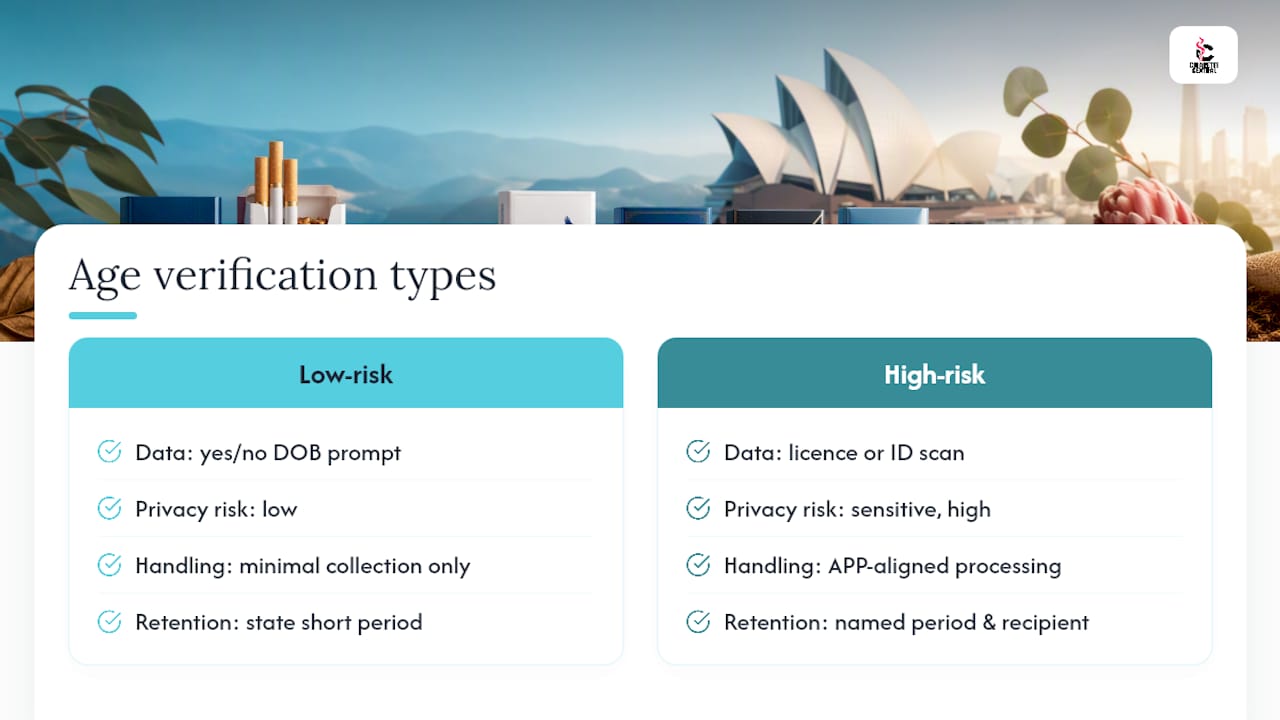
A date-of-birth prompt that simply asks “are you 18 or over?” with a yes/no click collects minimal personal information and carries low privacy risk. A system that requires uploading a driver’s licence or ID scan collects sensitive, high-risk data, and that data needs the same APP-aligned handling as payment details: a stated retention period, a named recipient (is it verified in-house or by a third-party service?), and a clear deletion process once verification is complete.
Parents and guardians should know that a minor circumventing an age gate is a compliance failure on the retailer’s side, not something the family needs to manage through the website itself. If a retailer’s age verification looks like a single checkbox with no real barrier, that’s a signal the site may not be taking either its advertising obligations or its data handling seriously. Legitimate operators tend to layer age verification with account-level checks at signup and again at delivery, which also reduces the amount of speculative data collected from browsers who never intend to purchase.
The practical takeaway for any retailer: collect the least amount of identifying information needed to confirm age, and be explicit in the privacy policy about how long that verification data is kept.
Guidance on data minimisation and retention practices for tobacco websites
Data minimisation means collecting only what’s needed for the transaction in front of you, and it’s one of the clearest signals of a well-run tobacco website. A retailer that asks for a full date of birth, home address and phone number at browsing stage, before you’ve added anything to a cart, is collecting more than the transaction requires.
Retention is the other half of the equation. The OAIC’s guidance on developing an APP privacy policy stresses that policies should explain not just what’s collected, but how long it’s kept and why. A tobacco retailer holding customer purchase history indefinitely for “marketing purposes” without a stated end date is a red flag; a retailer that specifies “order data retained for seven years for taxation and warranty purposes, then deleted” is giving you something you can actually assess.
Practical data minimisation for a tobacco website looks like:
- Age verification collecting a yes/no confirmation rather than a document scan wherever legally sufficient.
- Payment details tokenised by the payment gateway rather than stored on the retailer’s own servers.
- Marketing opt-ins kept separate from transactional data, so unsubscribing from emails doesn’t require deleting your order history.
- A stated deletion or anonymisation process for dormant accounts.
If you’re comparing tobacco websites, the length and specificity of the retention section in the privacy policy tells you more than any trust badge on the homepage.
Editorial perspective: balancing privacy, compliance and shopper discretion
Most privacy policies read like legal insurance, not customer information. What actually matters is whether a tobacco retailer tells you, in plain terms, who touches your data between checkout and delivery. Discreet packaging protects your privacy at the door; a clear policy protects it everywhere else. For Tobacco Act specifics, contact TobaccoCompliance@health.gov.au directly rather than relying on a retailer’s own interpretation.
— Local Cigarette
Shopping with privacy in mind at Cigarette Central
Cigarette Central is built around the parts of this checklist that matter most at checkout: secure payment processing that doesn’t store your card details, discreet packaging so deliveries arrive without announcing their contents, and express shipping typically within 2 to 5 business days. Customer support is available 24/7 if you’ve got questions about how your order data is handled before it ships. For shoppers after a cheap cigarette online option without compromising on how their information is treated, the Cigarette Central storefront runs sales offering up to 30% off popular brands, alongside the Express Shipping add-on for faster delivery. Browse the current cigarette range, check the privacy policy against the checklist above, and place an order with a retailer that’s upfront about where your data goes.
Sources
- Australian Privacy Principles — quick reference (OAIC)
- Guide to online point-of-sale advertising requirements (Department of Health)
- Public Health (Tobacco and Other Products) Act 2023 (WIPO WIPOLEX)
FAQ
Is it illegal to buy tobacco online in Australia?
It depends on your state or territory and the seller’s compliance. Some jurisdictions restrict or prohibit online tobacco sales outright, so check your local rules before ordering rather than assuming national legality applies everywhere.
Do I need a privacy policy on my website in Australia?
If your business is an APP entity, generally with turnover above $3 million or handling certain sensitive data, you need a privacy policy meeting APP 1.3 to 1.5. It must be clearly expressed, current, and free to access.
Is tobacco advertising banned in Australia?
Tobacco advertising is heavily restricted rather than fully banned online. The Department of Health’s point-of-sale guidance permits basic product listings with warnings, but discount promotion, lifestyle imagery and social sharing typically cross into prohibited advertising.
What is the new tobacco law in Australia?
The Public Health (Tobacco and Other Products) Act 2023 commenced on 1 April 2024 and consolidated Commonwealth tobacco controls, updating packaging, reporting and online advertising requirements.
What does Cigarette Central charge for shipping?
Cigarette Central’s Express Shipping is a $15 one-off fee, available at checkout on the Cigarette Central site alongside its standard delivery options.
Recommended
- Avoid Scam Tobacco Sites in Australia with ABN Checks and 3 Safe Picks
- Buying tobacco online in Sydney: 2026 guide
- Buy cigarettes online safely in Australia: legal, discreet guide
- PayPal Blocks Tobacco in Australia: Avoid Illicit Rails, Buy Safely
Online Cigarette Central provided article for general information only and is not professional advice. Some Suitable For +18 Only, Call Your Quit Line For Help.


