












You cannot import cigarettes or loose tobacco into Australia through international mail. The Australian Border Force seizes and destroys detected shipments, and state regulators plus Australia Post and private couriers enforce their own bans on top of that. The only narrow exception covers cigars and oral snuff, and even then you need to declare the goods and pay duty.
TL;DR:
- Sending cigarettes or loose tobacco into Australia via international mail is strictly prohibited, with border seizures and destruction being standard enforcement.
- Only cigars and oral snuff can sometimes be imported under declaration and duty payment within strict quantity limits, but no similar pathway exists for cigarettes or loose tobacco.
- Domestic tobacco sales require proper licensing, with penalties reaching millions for unlicensed selling, and online and retail outlets must hold valid state licences.
- Legitimate tobacco imports occur only through licensed channels like authorized air or sea cargo with permits and proper duty payment; personal courier importation is not permitted.
- Vape products face similarly strict restrictions, often requiring prescriptions, and courier shipments will be heavily scrutinized or rejected if not compliant.
Table of Contents
- Australian Border Force rules: importing tobacco by mail and courier
- Domestic rules: state and territory licensing, retail rules and delivery restrictions
- How to lawfully send or receive tobacco in Australia
- Courier and postal operator policies: AusPost and private couriers’ conditions of carriage
- Penalties, enforcement and practical risks if you try to courier tobacco
- What compliant Australian retailers and couriers do
- Product comparison: Cigarette Central catalogue items and their delivery notes
- Cross-border courier shipments from Papua New Guinea and New Zealand
- Impact of the Tobacco Plain Packaging Act on couriered tobacco products
- Detailed procedures for declaring tobacco shipments to Australian authorities
- Excise-equivalent customs duty rates and taxation implications for imported tobacco
- Personal importation via courier: what’s actually allowed
- Vaping and e-cigarette products in courier shipments
- Compliance matters more than convenience
- How Cigarette Central offers a lawful way to buy
- Sources
- FAQ
Australian Border Force rules: importing tobacco by mail and courier
The rule is blunt: cigarettes and loose-leaf tobacco sent to Australia through international mail get pulled at the border. The Australian Border Force treats this as a straightforward prohibition, not a grey area, and detected parcels are seized and destroyed with very limited exceptions.
Those exceptions are narrow. Cigars and oral snuff can sometimes come through, but only within set quantity limits and only when you declare them and pay the applicable duty upfront. There’s no equivalent pathway for cigarettes or loose tobacco through the mail system, no matter how the parcel is packaged or labelled.
The duty rate makes the point for you. Excise-equivalent customs duty on tobacco sits at $2,445.26 per kilogram or $1.52829 per stick as of March 2026, a rate high enough that private import would rarely make financial sense even if it were legal.
Why can’t you just use a courier instead of the post? Because the restriction isn’t really about the mail service, it’s about the goods. A few things follow from that:
- International mail and small parcel couriers are not approved channels for commercial-style tobacco import, regardless of carrier.
- Authorised air and sea cargo exists for licensed importers, but it requires import permits, customs documentation and duty payment that private buyers rarely have set up.
- Discreet packaging or express labelling changes nothing about legality; it only changes how a parcel looks before it’s opened.
For everyday buyers, the practical reality is that there’s no shortcut. If a seller ships tobacco to Australia by international post, that shipment is not compliant, and you carry the risk if it’s seized.
Domestic rules: state and territory licensing, retail rules and delivery restrictions
Once tobacco is already inside Australia, the rules shift from border control to state licensing. Every state and territory requires retailers, wholesalers and online stores to hold a valid tobacco licence before they can sell to the public, and that licensing requirement is what separates a legitimate seller from one operating outside the law.
NSW Health’s tobacco licensing scheme requires a licence for each retail outlet, and that includes online stores, which need a retail licence tied to the business even though there’s no physical shopfront. Western Australia and Victoria run comparable schemes, with their own registration processes and compliance checks.
These licensing rules interact directly with how tobacco gets dispatched and sold:
- Retailers must display licence details and comply with plain packaging and point-of-sale display restrictions before a product can be advertised or sold at all.
- Vending machine sales are heavily restricted or banned in most jurisdictions, pushing legitimate supply through licensed retail and online channels.
- Online sellers are expected to verify licensing status the same way a bricks-and-mortar shop would, since state regulators treat the sales channel as secondary to the licence itself.
Penalties for skipping this step are not trivial. Western Australian guidance notes that selling tobacco without a licence can attract penalties up to $1.2 million for individuals and $6 million for companies in some circumstances, and closure orders can shut an unlicensed operation down entirely. If you’re comparing where to buy cheap cigarette online, licensing status is the first thing worth checking, not the price.
How to lawfully send or receive tobacco in Australia
There are a small number of pathways that actually work within the law, and they look nothing like ordering from an overseas seller and hoping the parcel gets through.
- Traveller duty-free allowances apply when you’re physically crossing the border yourself, not when goods are mailed on your behalf; limits are fixed and enforced at arrival.
- Licensed commercial import happens through authorised air or sea cargo, with import permits, customs declarations and duty paid before goods clear the border. This is how legitimate wholesalers and retailers, including online sellers, actually stock product.
- Domestic purchase from a licensed Australian retailer is the practical option for most smokers, since the product is already duty-paid and compliant once it’s in the country.
Before you buy from any online seller, run a short checklist: confirm the retailer holds a current state licence, check that the carrier accepts tobacco under its terms of carriage, make sure packaging meets plain packaging and health warning standards, and confirm age verification happens at the point of delivery, not just at checkout.
Pro Tip: Search for the retailer’s tobacco licence number on the relevant state health department’s public register before you place an order, not after.
Guides like Cigarette Central’s overview of reliable online tobacco shipping walk through what compliant dispatch actually looks like in practice.
Courier and postal operator policies: AusPost and private couriers’ conditions of carriage
Carriers add their own layer of restriction on top of government rules, and it’s worth understanding both. Australia Post’s prohibited and restricted items list names nicotine and tobacco products as prohibited for standard international post, with contract customers occasionally able to negotiate exemptions under specific terms.
Private couriers run similar policies, and this matters for anyone assuming a courier company might be more permissive than the post office:
- Express service and discreet packaging are marketing features, not legal workarounds; they do nothing to change whether a shipment is permitted.
- Most private couriers align their conditions of carriage with ABF rules specifically to avoid liability for prohibited goods passing through their network.
- Contract customers with commercial agreements sometimes have different terms, but that arrangement is between a licensed business and the carrier, not something an individual buyer can access.
If you’re checking whether a seller’s delivery promise is realistic, read the carrier’s conditions of carriage yourself rather than taking a shipping page at its word.
Penalties, enforcement and practical risks if you try to courier tobacco
The consequences of ignoring these rules land on both ends of the transaction. Border Force seizes and destroys prohibited tobacco detected in international mail, and the sender and recipient can both face liability, not just the shipping company.
At the state level, penalties escalate quickly. Closure orders can shut down an unlicensed retail operation immediately, and fines in some jurisdictions reach into the millions for repeat or serious breaches, as WA’s guide for selling tobacco products sets out. Criminal exposure is also possible for deliberate, large-scale unlicensed trading.
Beyond the legal risk, there are practical downsides worth weighing:
- Money paid to an unlicensed or overseas seller is usually gone for good once a shipment is seized, since there’s rarely a refund process.
- Buying from unlicensed channels can end up funding illicit supply chains that operate entirely outside tax and safety oversight.
- A seized parcel can also mean lost time, a paper trail with your name on it, and no product to show for either.
Excise-equivalent duty rates of $2,445.26 per kilogram mean that even a hypothetical legal import would rarely be cheaper than buying through a licensed domestic retailer.
What compliant Australian retailers and couriers do
A lawful tobacco retailer in Australia builds its whole operation around licensing, age verification and duty-paid stock, not just fast delivery. That’s the standard worth measuring any seller against before you buy.
- Retailers should be able to show a current state tobacco licence and produce invoices proving stock is duty-paid.
- Age verification should happen at both checkout and delivery, not as an afterthought.
- Packaging should meet plain packaging and health warning requirements set out under the Public Health (Tobacco and Other Products) Act 2023.
- Secure payment processing and round-the-clock customer support are reasonable service expectations, not proof of legality on their own.
Cigarette Central’s own guidance on courier services in tobacco delivery covers what last-mile compliance looks like from a retailer’s side.
Product comparison: Cigarette Central catalogue items and their delivery notes
Anyone searching for cheap cigarette online tends to compare a handful of the same things: pack size, blend, and how fast it actually turns up. Here’s how three of Cigarette Central’s own catalogue items stack up on those points.
- Premium Loose Tobacco 500g suits smokers who roll their own and want a rich, smooth blend without committing to a bulk order.
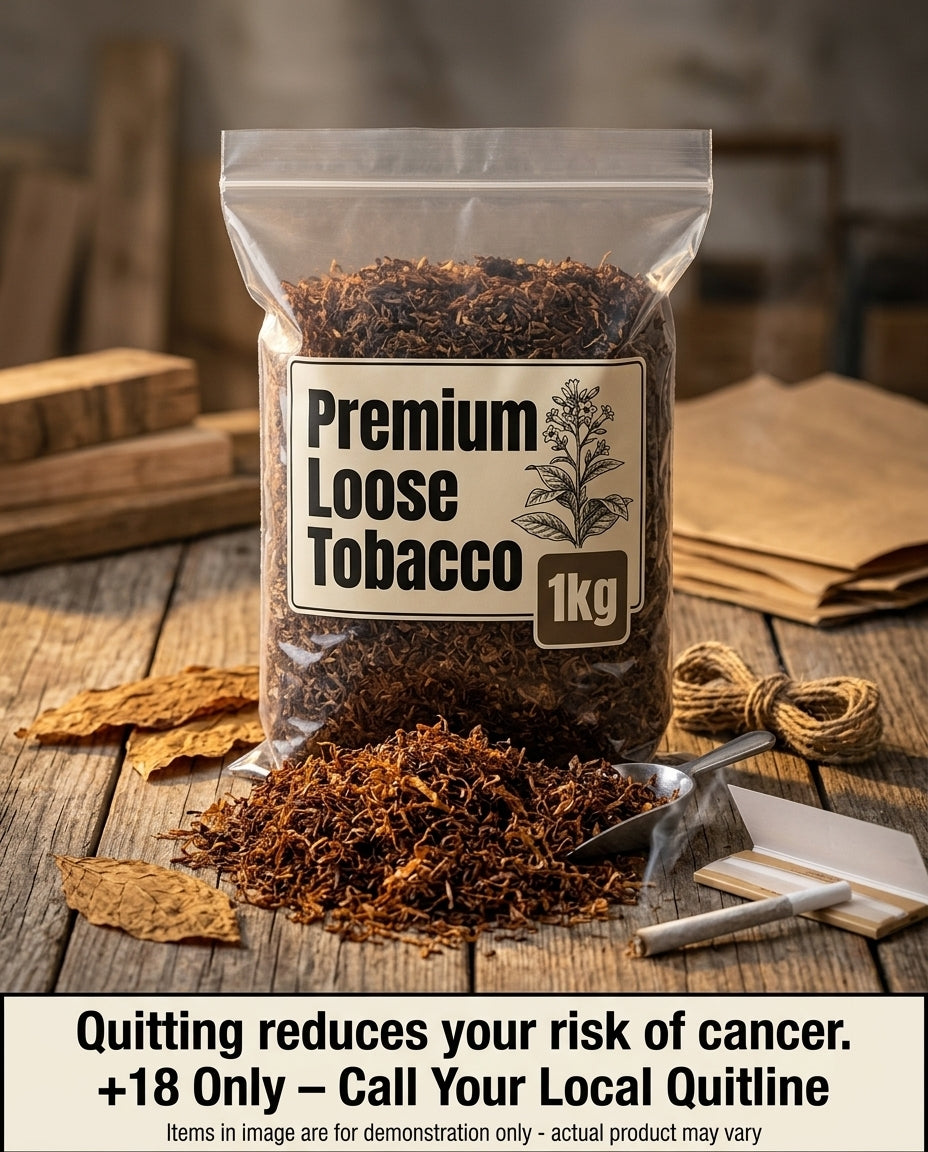
- Premium Loose Tobacco 1kg is the better-value option for regular rollers who want more control over flavour and fewer reorders.
- Mevius Premium Light Charcoal No.8 Cigarettes, sold as 20s across 10 packs, gives a smooth charcoal filter for smokers who prefer a lighter cigarette.
Every item dispatches in compliant plain packaging with health warnings intact, and age verification applies at checkout and again at delivery. Before you order, check stock availability and estimated delivery time on the product page itself, since dispatch windows can shift with demand.
Cross-border courier shipments from Papua New Guinea and New Zealand
Australia’s geography puts it close to Papua New Guinea and within easy courier reach of New Zealand, which raises a specific question: does proximity change the rules? It doesn’t. Shipments arriving from neighbouring territories go through the same Border Force screening as parcels from anywhere else in the world.
There’s no regional carve-out for New Zealand or Pacific courier routes. A parcel containing cigarettes or loose tobacco sent from Auckland or Port Moresby is treated identically to one sent from anywhere else, because the prohibition attaches to the goods, not the point of origin. Border Force’s guidance on mail versus cargo makes clear that international mail is not an approved method for commercial tobacco import regardless of which country it departs from.
This trips up plenty of people who assume a short courier hop across the Tasman or the Coral Sea carries less scrutiny than a shipment from Europe or Asia. It doesn’t. Distance and transit time have no bearing on whether Border Force intercepts the parcel, and the seizure and destruction outcome is the same either way. If anything, high courier volume on these regional routes means screening is well established and consistent, not relaxed.
For anyone in Australia expecting a courier delivery from a neighbouring country, the safest assumption is that tobacco products won’t clear customs, and budgeting on that basis avoids a wasted purchase.
Impact of the Tobacco Plain Packaging Act on couriered tobacco products
Plain packaging law shapes what a lawful tobacco shipment is allowed to look like once it’s inside Australia, and it matters for courier delivery specifically because packaging is one of the first things a carrier or regulator checks. Products must carry standardised health warnings and drab, uniform packaging with no branding elements designed to make the product more appealing.
The framework has been consolidated and updated under the Public Health (Tobacco and Other Products) Act 2023, which brought plain packaging requirements together with newer reporting and product standard rules during transition periods running through 2024 and 2025. Any tobacco product legally sold and delivered within Australia today needs to meet these packaging standards, regardless of whether it’s collected in person or delivered by courier.
For couriered domestic orders, this means a compliant retailer’s parcel should contain product in standardised packaging, not the branded retail packaging you’d see overseas. It’s a useful check for buyers: if a product arrives looking like imported retail packaging rather than the plain, warning-labelled format required here, that’s a signal the product didn’t come through a compliant local supply chain.
Plain packaging compliance sits alongside licensing as one of the clearest indicators that a courier delivery is legitimate. A seller who gets the packaging wrong is unlikely to have the rest of the compliance chain right either.

Detailed procedures for declaring tobacco shipments to Australian authorities
Declaration only comes into play for the narrow exceptions Border Force allows, mainly cigars and oral snuff within set limits, since cigarettes and loose tobacco can’t be mailed in regardless of declaration. If you’re bringing in permitted goods, the process starts with an accurate customs declaration listing the product type, quantity and value.
Duty must be calculated and paid before or at the point of clearance. The excise-equivalent duty rates that apply are the same ones used for cigarettes and loose tobacco, calculated per kilogram or per stick depending on the product, and Border Force will hold or return goods until duty is settled.
Documentation matters as much as the declaration itself. Anyone importing through authorised commercial cargo channels, rather than the narrow personal exceptions, needs import permits and supporting paperwork that show the shipment is legitimate and duty-paid before it moves. This is a fundamentally different process to filling out a customs form for a personal parcel, and it’s why private buyers rarely attempt it.
If a declaration is incomplete, inaccurate or missing altogether, Border Force treats the shipment as non-compliant and it’s seized. There’s no process to “fix” a seizure after the fact for prohibited items like cigarettes; the declaration step only helps for the specific exceptions the law actually allows, and even then, getting it wrong means losing the goods.

Excise-equivalent customs duty rates and taxation implications for imported tobacco
Duty is the financial reality that sits behind every tobacco import rule in Australia, and it’s steep by design. As of March 2026, excise-equivalent customs duty runs to $2,445.26 per kilogram or $1.52829 per stick, figures set out in Border Force’s own guidance on posted and mailed imports.
These rates apply whether tobacco arrives through the narrow personal exceptions or through authorised commercial cargo, and they’re adjusted periodically through customs tariff notices, including rate updates published for 2026. The scale of the duty means legitimate import, even where it’s technically permitted, rarely competes on price with buying duty-paid stock from a licensed Australian retailer.
For everyday smokers, the taxation angle explains why local licensed retail exists as the practical option rather than an inconvenience. Duty has already been paid somewhere in the supply chain for compliant domestic stock, which is part of why a retailer’s licensing and invoicing matter: they’re the paper trail showing that duty was actually settled rather than avoided.
Attempting to bypass this by mailing tobacco in from overseas doesn’t just risk seizure, it also assumes an economic shortcut that the duty structure is specifically designed to close off.
Personal importation via courier: what’s actually allowed
Courier services occupy an odd middle ground in people’s minds, somewhere between international mail and carrying goods yourself, but the law doesn’t treat it that way. For cigarettes and loose tobacco, there is no personal importation exemption that applies to courier or mail delivery specifically.
The only personal-use exceptions Border Force recognises are for cigars and oral snuff, within defined quantity limits, and only with declaration and duty paid. There’s no equivalent allowance that lets an individual receive cigarettes or loose tobacco by courier for personal use, no matter how small the quantity.
This is worth stating plainly because a lot of confusion comes from mixing up traveller duty-free allowances, which apply only when you personally cross the border, with courier or mail delivery, which doesn’t get any equivalent personal-use carve-out. A traveller can carry a limited amount through customs in person. A courier cannot replicate that allowance on someone’s behalf.
For anyone considering ordering tobacco from overseas for personal use and having it couriered in, the practical answer is that it isn’t a viable path for cigarettes or loose tobacco. The exceptions that exist are narrow, product-specific, and require formal declaration, not a discreet parcel arriving unannounced.
Vaping and e-cigarette products in courier shipments
Vaping products sit under a separate but similarly strict framework. Nicotine vaping products in Australia require a prescription for personal importation in most circumstances, and retail sale outside of pharmacy channels is heavily restricted under reforms tied to the Public Health (Tobacco and Other Products) Act 2023.
Couriers and Australia Post apply their own restrictions on top of this, generally treating nicotine-containing vaping products the same way they treat tobacco: as prohibited or heavily restricted items for standard parcel delivery. That means a courier shipment of vapes faces the same kind of scrutiny as a tobacco shipment, plus the added complication of needing valid prescription documentation for many products.
Disposable vapes and e-cigarettes without a prescription pathway face even tighter restrictions, reflecting recent regulatory tightening around youth vaping access. The practical upshot for anyone trying to have vaping products couriered into Australia is similar to tobacco: the exceptions are narrow, documentation-heavy, and not something a standard parcel delivery can satisfy.
If you’re weighing up tobacco versus vaping products from a courier compliance angle, neither offers a simple workaround. Both sit under frameworks built specifically to keep unregulated product out of casual parcel delivery.
Compliance matters more than convenience
The strict rules around couriering tobacco aren’t bureaucratic friction for its own sake. They exist to keep duty-paid, plain-packaged, age-verified product as the only thing legally reaching Australian smokers, and to starve out supply chains that skip all three. Buying from a licensed seller and a carrier that follows the rules protects you as much as it protects the system.
— Local Cigarette
How Cigarette Central offers a lawful way to buy
Given all these restrictions, the simplest lawful path is buying from a licensed Australian retailer that’s already built its dispatch process around the rules. Cigarette Central operates on that basis: age verification at checkout, plain packaging compliance on every product, and secure payment processing that doesn’t store your card details.
- Orders typically dispatch with fast delivery within 2 to 5 business days, backed by an Express Shipping option at $15 one-off for anyone who wants it sooner.
- The catalogue includes Cigarettes, Premium Loose Tobacco, Golden Virginia Tobacco and Drum Blue Tobacco, all dispatched in compliant packaging.
- Customer support is available to assist with order questions or delivery tracking.
Before you order from anywhere, check the seller’s licensing status, confirm the carrier’s terms of carriage, and make sure packaging meets Australian standards. Browse the full range at Cigarette Central and check current stock and delivery estimates before checkout.
Sources
If you want to check any of this yourself before ordering, these are the primary sources worth bookmarking.
- Importing by post or mail | Australian Border Force
- AusPost prohibited and restricted items list
- New legislation for tobacco and other products | Department of Health
- NSW tobacco licensing scheme | NSW Health
FAQ
Is it illegal to send tobacco in the mail in Australia?
Yes, sending cigarettes or loose tobacco through international mail to Australia is prohibited, and Border Force seizes and destroys detected shipments. Domestic posting within Australia between licensed businesses is different, but it still has to comply with state licensing and carrier terms.
Are you allowed to send tobacco in the mail?
Within Australia, only licensed retailers and wholesalers can lawfully dispatch tobacco, and Australia Post’s own prohibited items policy restricts nicotine and tobacco products for standard postage. Internationally, sending cigarettes or loose tobacco to Australia by mail is not permitted at all.
Can tobacco be delivered in Australia?
Yes, licensed Australian retailers can legally deliver tobacco domestically through couriers that accept these goods under their terms of carriage. Delivery still requires age verification and plain packaging compliance, and the seller needs a valid state tobacco licence.
What are the current restrictions on tobacco in Australia?
Tobacco is legal to buy and sell domestically through licensed retailers, but international mail import of cigarettes and loose tobacco is banned, and excise-equivalent duty of $2,445.26 per kilogram applies to imports where allowed. State licensing schemes, plain packaging law and Border Force seizure powers all apply on top of that.
Can I import tobacco personally through a courier for my own use?
No, there’s no personal-use exemption for cigarettes or loose tobacco delivered by courier, regardless of quantity. The only narrow exceptions cover cigars and oral snuff within set limits, and those still require declaration and duty payment.
Recommended
- 25 Cigarettes Duty Free Limit: Stay Legal, Buy Locally in Australia
- Skip Import Rules: Get Discount Tobacco in Australia in 2–5 Days
- Duty-free tobacco in Australia: what travellers need to know
- Role of courier services in tobacco delivery in Australia
Online Cigarette Central provided article for general information only and is not professional advice. Some Suitable For +18 Only, Call Your Quit Line For Help.


