





A 50g pouch of roll-your-own (RYO) tobacco produces roughly between the typical lower and upper cigarette counts for most smokers, depending on how much tobacco you pack into each one. The formula is simple:
50 ÷ grams per cigarette = number of cigarettes
Here are the quick numbers for the most common roll sizes:
- 0.5 g per cigarette → 100 cigarettes
- 0.6 g per cigarette → 83 cigarettes
- 0.7 g per cigarette → 71 cigarettes
- 0.8 g per cigarette → 63 cigarettes
- 1.0 g per cigarette → 50 cigarettes
Most Australian RYO smokers land somewhere between 0.5 g and 0.7 g per cigarette, which puts a 50g pouch in a range around 70 to 100 cigarettes. The 0.8 g figure is the Australian government’s excise equivalence, not a consumer average — more on that below.
Pro Tip: Weigh one of your finished rolls on a kitchen scale before you light it. That single number tells you exactly where you sit on the table above.
Key takeaways
A 50g pouch yields 63–100 cigarettes for most Australian RYO smokers, with the exact count determined by your grams per cigarette — weigh a sample roll and divide 50 by that number for a personalised result.
| Point | Details |
|---|---|
| Quick BLUF numbers | 50g gives 100 cigarettes at 0.5 g/roll, 83 at 0.6 g, 71 at 0.7 g, 63 at 0.8 g. |
| The formula | Pouch grams ÷ grams per cigarette = estimated count; subtract 2–3 for waste. |
| Consumer average | Most RYO smokers use 0.42–0.50 g per cigarette in lab and field studies. |
| Excise vs real use | Australia’s 0.8 g excise equivalence is a tax policy figure, not a consumer average. |
| Buy larger pouches | Cigarettecentral stocks 500g loose tobacco for fewer reorders, shipped Australia-wide in 2–5 days. |
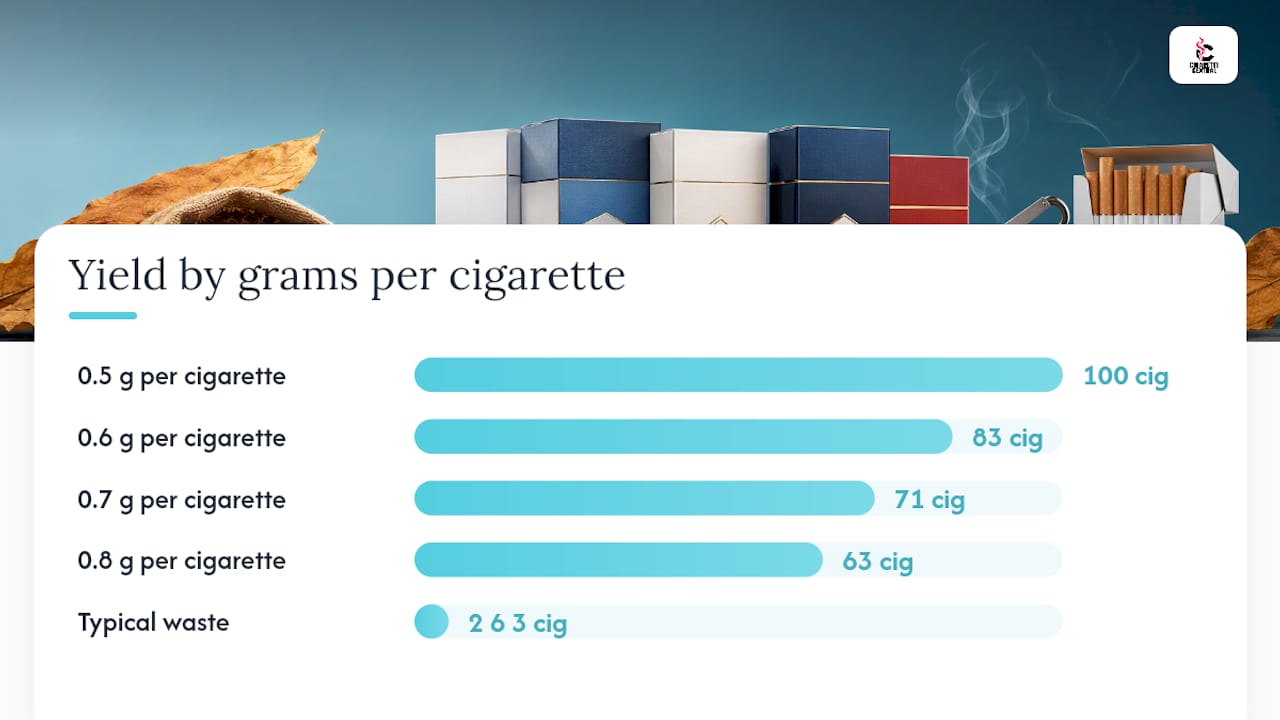
Table of Contents
- How do you calculate cigarettes from 50g yourself?
- What affects how many cigarettes you actually get?
- How long does a 50g pouch last at different usage levels?
- Why does Australia’s excise use 0.8g, not your actual roll weight?
- Does rolling lighter cigarettes make them safer?
- What smokers around Australia are saying
- Stock up on larger pouches at Cigarettecentral
- Sources
- FAQ
How do you calculate cigarettes from 50g yourself?
The maths takes about five seconds. Divide the pouch weight by your grams per cigarette.
- Decide your grams per cigarette. If you don’t know it yet, 0.6 g is a reasonable starting estimate for a moderately packed roll.
- Divide 50 by that number. 50 ÷ 0.6 = 83.3, so round down to 83.
- Account for waste. Loose tobacco at the bottom of a pouch, stray strands, and torn papers typically cost you 1–3 g per pouch. Subtract 2–3 cigarettes from your total as a practical buffer.
Worked example 1 — light roller (0.5 g): 50 ÷ 0.5 = 100 cigarettes. Minus 2 for waste: 98 usable cigarettes.
Worked example 2 — heavier roller (0.8 g): 50 ÷ 0.8 = 62.5, rounded down to 62. Minus 2 for waste: 60 usable cigarettes.
A quick mental shortcut: think of 50 g at 0.5 g as your 100-cigarette baseline. Every 0.1 g you add per cigarette, you lose roughly 8–12 cigarettes from that total. So a 0.7 g roller gets about 71, and a 0.8 g roller gets about 63.
Pro Tip: Roll five cigarettes, weigh them together on a kitchen scale, then divide by five. Averaging multiple rolls gives you a far more reliable personal figure than weighing just one.
What affects how many cigarettes you actually get?
Your yield isn’t fixed — several variables push it up or down. Research comparing lab-made and consumer-rolled cigarettes confirms that RYO weights and smoke yields vary substantially with tobacco weight, paper choice, and filter use.
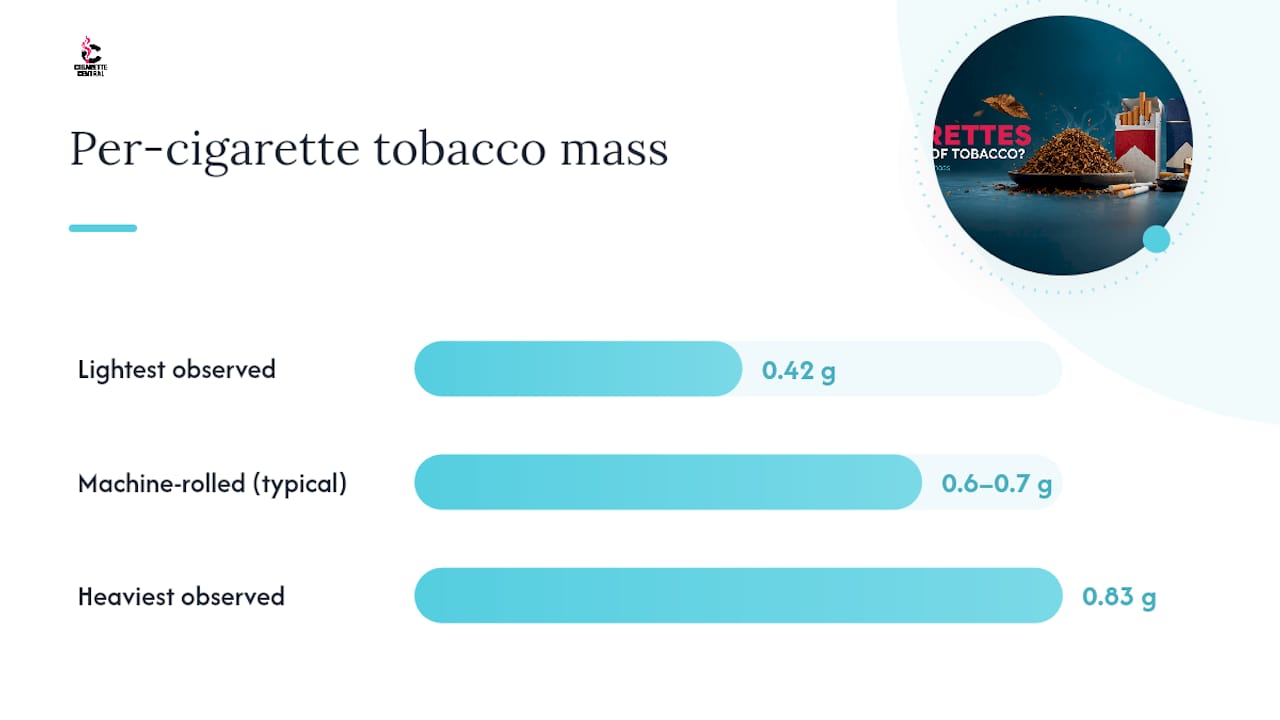
Experimental measurements of hand-rolled and tube-filled cigarettes show per-cigarette masses ranging from roughly 0.42 g to 0.83 g across different formats, which lines up with the table above.
Key variables that shift your count:
- Filters. A filter takes up tube space, so filtered rolls often use slightly less tobacco per cigarette than unfiltered ones.
- Paper porosity. More porous papers burn faster, which can lead smokers to pack more tobacco without realising it.
- Rolling machine vs hand. A machine produces consistent, tightly packed cigarettes — usually 0.6–0.7 g. Hand rolling varies more widely.
- Packing density. A loosely packed roll uses less tobacco but burns faster; a tight roll uses more and lasts longer.
- Tobacco moisture. Damp tobacco weighs more per pinch, so you may use fewer grams than you think. Slightly drier tobacco gives more predictable weights.
For a closer look at how different blends behave when rolling, the RYO tobacco comparison guide covers popular Australian options side by side.
How long does a 50g pouch last at different usage levels?
Using 0.6 g per cigarette (83 cigarettes per pouch) as the base:
- Light smoker — 5 cigarettes per day: 83 ÷ 5 = 16–17 days per pouch. Roughly one pouch per fortnight.
- Moderate smoker — 10 cigarettes per day: 83 ÷ 10 = 8 days per pouch. Just over one pouch per week.
- Heavy smoker — 20 cigarettes per day: 83 ÷ 20 = 4 days per pouch. About seven pouches per month.
Pack equivalents (based on 20 cigarettes per factory pack):
- 83 cigarettes ÷ 20 = roughly 4 factory packs from one 50g pouch at 0.6 g per roll
- At 0.5 g per roll (100 cigarettes), that rises to 5 factory packs
- At 0.8 g per roll (63 cigarettes), it drops to just over 3 factory packs
Anecdotal reports from RYO smokers suggest personal yields range from about 50 up to 200 cigarettes per 50g pouch, depending on roll size and technique — a reminder that your own measurement matters more than any general estimate.
Why does Australia’s excise use 0.8g, not your actual roll weight?
Australian excise policy uses an equivalisation weight of 0.8 g per cigarette when converting loose tobacco to a cigarette count for taxation purposes. That figure is a policy tool designed to align the tax burden on loose tobacco with factory-made cigarettes — not a measurement of how much tobacco consumers actually use.
The gap matters: consumer RYO cigarettes in lab and field studies typically weigh 0.42–0.50 g, roughly half the excise equivalence weight.
What this means in practice:
- Packaging claims that reference cigarette equivalents are calculated at 0.8 g, so they will always show a lower count than most smokers actually get.
- Price comparisons between RYO and factory cigarettes based on excise equivalence understate the value of a pouch for lighter rollers.
- Your real yield at 0.5 g per cigarette is 100 cigarettes from 50g — 37% more than the 63 the excise formula implies.
The Australian Government Department of Health has also standardised certain pouch sizes and packaging configurations, which affects how products are presented at retail — another reason the numbers on a pouch don’t always match your lived experience.
Does rolling lighter cigarettes make them safer?
No. Using less tobacco per cigarette does not make smoking safe or low risk. Studies show that reducing tobacco mass per cigarette produces some reduction in smoke emissions, but the effect is blend-dependent and not uniform across nicotine, tar, and carbon monoxide. A lighter roll is not a safer cigarette.
Practical tips for consistent, predictable rolling:
- Use a kitchen scale. Roll five cigarettes, weigh them together, divide by five. This is the most reliable way to find your personal grams per cigarette.
- Try a rolling machine. Machines produce uniform rolls, which makes your per-pouch count far more predictable.
- Store tobacco at consistent moisture. Damp tobacco weighs more; dry tobacco weighs less. A small airtight container keeps moisture stable.
- Record your results. Note the weight and how many cigarettes you got. After two or three pouches, you’ll have a reliable personal average.
Pro Tip: Tobacco control research recommends weighing and averaging multiple sample rolls — not just one — for the most accurate personal estimate.
For support with quitting, visit the Quitline at quitline.org.au.
What smokers around Australia are saying
Smokers across Australia — from Brisbane and Melbourne to Perth and Adelaide — report a wide range of yields from a 50g pouch, and the difference usually comes down to one thing: how tightly they roll.
One regular customer from Sydney shared this:
“I switched to a rolling machine about six months ago and started weighing my rolls out of curiosity. I was averaging 0.55 g per cigarette, which works out to about 90 cigarettes from a 50g pouch. I’d always assumed I was getting around 70. Knowing the real number helped me plan my orders better — I now buy the 500g loose tobacco from Cigarettecentral every few weeks instead of chasing smaller pouches constantly.”
Smokers in regional areas — Cairns, Ballarat, Toowoomba — often mention that ordering online removes the hassle of local stock shortages, particularly for less common blends. Whether you’re rolling Golden Virginia in Hobart or Drum Blue in Darwin, knowing your grams per cigarette lets you order with confidence rather than guessing when you’ll run out.
If you’ve measured your own rolls, the formula works the same way for any pouch size. For 25g tobacco, simply divide 25 by your grams per cigarette — at 0.5 g, that’s 50 cigarettes; at 0.6 g, it’s 41.
Stock up on larger pouches at Cigarettecentral
Buying a 50g pouch every week adds up in both cost and effort. Cigarettecentral’s tobacco category carries larger options — including a 500g premium loose tobacco that gives moderate rollers roughly 830 cigarettes per order, cutting your reorder frequency to once a month or less.
Every order ships with discreet packaging and secure payment processing, with delivery across Australia in 2–5 business days. Browse the full range, check current deals (up to 30% off during sales), and place your order at Cigarettecentral.
Sources
- 13.6 What tobacco taxes apply in Australia? - Tobacco in Australia
- Roll-your-own smoke yields: theoretical and practical aspects
- Tobacco - Australian Government Department of Health
- An investigation on RYO/MYO tobacco characteristics and smoke emissions as a function of cigarette design elements
This article is general information, not a substitute for advice from a qualified doctor. Consult a qualified healthcare professional about your own circumstances before acting on anything here.
FAQ
How many cigarettes can you roll from 50g?
At the most common consumer weight of 0.5–0.6 g per cigarette, a 50g pouch produces roughly 83–100 cigarettes. Heavier rollers using 0.8 g get about 63.
How long does 50g of tobacco last you?
At 10 cigarettes per day and 0.6 g per roll (83 cigarettes per pouch), a 50g pouch lasts about 8 days. Light smokers at 5 per day stretch it to 16–17 days.
How many cigarettes do you get from 25g of tobacco?
Divide 25 by your grams per cigarette. At 0.5 g, that’s 50 cigarettes; at 0.6 g, it’s 41. The same formula applies to any pouch size.
How many factory packs does a 50g pouch equal?
At 0.6 g per roll (83 cigarettes), a 50g pouch is roughly equivalent to four standard factory packs of 20. At 0.5 g per roll, it’s closer to five packs.
Why does the packet say fewer cigarettes than I actually roll?
Packaging equivalence figures use the Australian excise standard of 0.8 g per cigarette. Most consumers roll lighter than that, so your real yield is typically higher than the number on the pack.


