





TL;DR:
- Tobacco leaf type is classified by species, curing method, and stalk position, influencing flavor and nicotine. Virginia, Burley, Oriental, and Rustica each offer distinct characteristics suited for different preferences. Understanding these differences helps smokers choose products that match their taste, strength, and smoking style.
Tobacco leaf type is defined as the classification of a tobacco plant’s leaves by species, curing method, and position on the stalk, each producing a distinct flavour, sugar level, and nicotine content. The two main species are Nicotiana tabacum, which covers Virginia, Burley, and Oriental varieties, and Nicotiana rustica, a separate high-nicotine species. Understanding what is tobacco leaf type explained in practical terms means knowing that curing method shapes flavour more than variety alone. For Australian smokers, this knowledge directly affects which cigarettes, roll-your-own products, or pipe tobaccos suit your taste and strength preference.
What are the main tobacco leaf types and how do they differ?
The four primary tobacco leaf varieties are Virginia, Burley, Oriental, and Rustica. Each has a distinct character built by species, growing region, and how the leaf is cured after harvest.

Virginia (flue-cured brightleaf)
Virginia is the most widely used leaf in commercial cigarettes worldwide. Flue-Cured Virginia accounts for 50–70% of total leaf in international cigarette blends, driven by its clean burn and high natural sugar content. That sugar level gives Virginia its characteristic mild sweetness and golden colour. It burns evenly and consistently, which makes it the preferred base leaf for most blended cigarettes.
Burley (air-cured)
Burley is air-cured over 4–8 weeks, reducing its residual sugar to less than 1%. The result is a drier, nuttier leaf with a stronger body than Virginia. Burley’s porous structure is its defining trait. It absorbs flavouring casings like chocolate and vanilla better than any other leaf type, which is why it appears in so many blended and flavoured products.
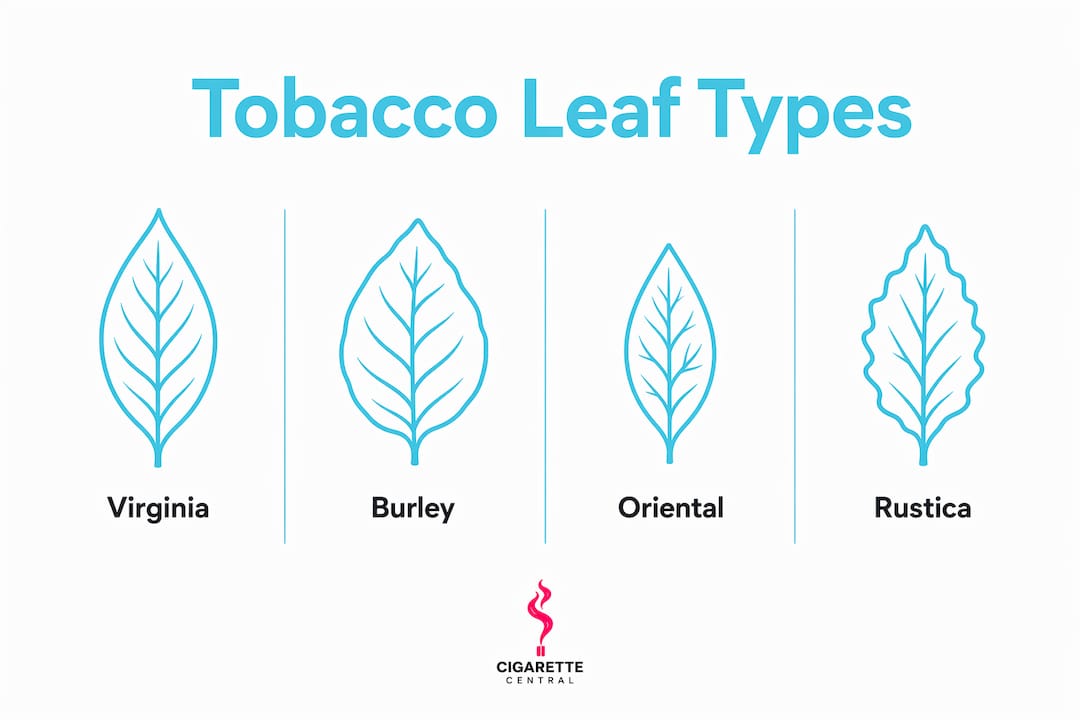
Oriental (sun-cured)
Oriental tobacco is a small-leafed variety grown primarily in Turkey, Greece, and the Balkans. Sun-curing stresses the plant through intense light exposure, triggering the formation of unique aromatic compounds. The result is a spicy, complex flavour used as a condiment leaf in blends. Oriental rarely appears as a standalone product. It adds depth and spice in small proportions.
Rustica (Nicotiana rustica)
Rustica is a separate species entirely. Nicotiana rustica contains 5–9% nicotine, which is three to five times higher than standard Nicotiana tabacum varieties. The leaf is thick, dark, and matures 10–15 days earlier than tabacum cultivars. Rustica is not common in mainstream commercial cigarettes. It appears in traditional products, certain pipe tobaccos, and some specialist blends.
Pro Tip: If you are new to tobacco leaf varieties, start with Virginia-dominant products. They give you the cleanest baseline for understanding how other leaf types change a blend’s character.
| Leaf type | Curing method | Sugar content | Key flavour trait | Typical use |
|---|---|---|---|---|
| Virginia | Flue-cured | High | Mild, sweet, clean | Base leaf in cigarettes |
| Burley | Air-cured | Very low (<1%) | Nutty, dry, full-bodied | Structure and flavour carrier |
| Oriental | Sun-cured | Low | Spicy, aromatic, complex | Condiment leaf in blends |
| Rustica | Varies | Low | Strong, earthy, pungent | Specialist and traditional use |
How do curing methods shape tobacco leaf characteristics?
Curing method primarily determines a leaf’s final flavour, colour, moisture, and nicotine profile. The leaf variety sets the starting point, but curing takes it to the finish line.
-
Flue-curing uses indirect heat from flues or pipes run through a barn. The process locks in natural sugars and produces the bright golden colour associated with Virginia leaf. The leaf dries quickly, preserving sweetness and producing a mild, clean smoke.
-
Air-curing hangs Burley leaf in ventilated barns for four to eight weeks. No artificial heat is applied. Sugars metabolise out of the leaf during this slow process, leaving a low-sugar, porous structure with a distinctly nutty, earthy character.
-
Sun-curing is unique to Oriental tobacco. Leaves are laid on racks under direct sunlight. The intense UV exposure stresses the plant’s cellular structure, producing aromatic compounds not found in other curing methods. This is the direct cause of Oriental’s signature spiciness.
-
Fire-curing suspends leaves over open hardwood fires. The smoke penetrates the leaf, creating a heavy, campfire-like flavour. Latakia, a Syrian and Cypriot tobacco used in English pipe blends, is the most recognised fire-cured product. It is rarely used in cigarettes but defines certain pipe tobacco styles.
Pro Tip: When you read a product description mentioning “Cavendish,” know that it is not a leaf variety. Cavendish is a processing technique applied to any tobacco type, using heat and pressure to release sugars and produce a sweeter, milder result. Most smokers confuse it for a leaf type.
The burn rate, nicotine delivery, and throat feel of any tobacco product trace back directly to its curing method. Two products made from the same Virginia leaf but cured differently will smoke noticeably differently.
What role do tobacco leaf types play in blends?
Most commercial tobacco products are blends, not single-leaf products. Blenders combine leaf types to achieve a target flavour, strength, and burn profile.
-
Virginia as the canvas. Virginia carries flavours without competing with other leaf types. Its mild sweetness and consistent burn make it the neutral foundation of most cigarette blends. Without Virginia, blends lose their structural consistency.
-
Burley as the backbone. Burley adds body and strength. Its porous leaf structure absorbs casing flavours like chocolate, vanilla, and caramel, which is why flavoured tobacco products rely heavily on Burley. It also slows burn rate, giving a longer smoke.
-
Oriental as the seasoning. Oriental appears in small proportions, typically 5–15% of a blend. It adds the spicy, aromatic complexity that separates a flat-tasting blend from a nuanced one. American blend cigarettes and Turkish-style products use Oriental most prominently.
-
Rustica in specialist products. Rustica’s extreme nicotine content means it is used sparingly or in specific traditional products. It is not a standard component of mainstream Australian cigarettes.
How leaf choice affects roll-your-own products
Roll-your-own smokers have more direct contact with leaf type decisions than factory cigarette smokers. Choosing a Virginia-dominant loose tobacco gives a lighter, sweeter smoke. A Burley-heavy blend delivers more body and a drier finish. Products like Golden Virginia and Drum illustrate this difference clearly. Golden Virginia leans on flue-cured leaf for sweetness, while Drum uses a Burley-influenced blend for a fuller, earthier character.
For pipe tobacco enthusiasts, the blend ratios matter even more. English pipe blends typically combine Virginia, Burley, and a small percentage of Oriental or Latakia. American-style blends favour Virginia and Burley without the Oriental component.
How can you choose tobacco leaf types to match your preferences?
Matching tobacco leaf types to your smoking preferences comes down to three factors: flavour profile, nicotine strength, and smoking style.
-
Light and sweet preference. Virginia-dominant products are your starting point. They deliver a mild, slightly sweet smoke with a clean finish. Most mainstream Australian cigarettes use Virginia as the primary leaf.
-
Full-bodied and earthy preference. Burley-heavy blends suit smokers who want more body and a drier, nuttier character. A Burley tobacco blend delivers noticeably more strength and a longer-lasting flavour on the palate.
-
Aromatic and complex preference. Oriental-influenced blends add spice and depth. These suit smokers who find straight Virginia too plain and want a more layered experience without jumping to high-nicotine products.
-
Nicotine strength. Rustica-based products carry the highest nicotine load. Standard Nicotiana tabacum blends vary in nicotine based on leaf position on the stalk. Upper stalk leaves carry more nicotine than lower leaves, regardless of variety.
-
Tobacco origin matters. Soil composition, climate, and altitude all affect flavour nuances within the same leaf type. Tobacco origin influences flavour in ways that curing alone cannot replicate. A Virginia leaf grown in Zimbabwe tastes different from one grown in North Carolina, even after identical flue-curing.
Pro Tip: Try a Virginia-dominant product, a Burley-dominant product, and an Oriental-blended product back to back before exploring specialty leaves. You will build a clear reference point for what each type contributes to a smoke.
Beginners should master Virginia, Burley, and Oriental before exploring specialty types. Jumping straight to Rustica or heavily fire-cured products without that baseline makes it harder to identify what you actually enjoy.
Key takeaways
Tobacco leaf type is defined by species and curing method, and these two factors together determine every meaningful difference in flavour, nicotine strength, and burn quality across all tobacco products.
| Point | Details |
|---|---|
| Virginia dominates blends | Flue-Cured Virginia makes up 50–70% of most commercial cigarette blends due to its clean burn and natural sweetness. |
| Curing drives flavour | Curing method shapes colour, sugar, nicotine, and flavour more than leaf variety alone. |
| Burley absorbs flavourings | Burley’s porous, low-sugar structure makes it the primary carrier of added casings in flavoured products. |
| Oriental adds complexity | Sun-cured Oriental leaf contributes spicy aromatic compounds used as a condiment in small blend proportions. |
| Cavendish is a process, not a leaf | Cavendish is a heat-and-pressure processing technique applied to any leaf type, not a distinct tobacco variety. |
What I have learned from years of watching smokers choose the wrong leaf
Most smokers pick products based on brand or price. Very few consider the leaf type underneath the packaging. That is a gap worth closing.
The single most common mistake I see is treating all tobacco as interchangeable. A smoker who finds Virginia-dominant cigarettes too mild switches to a stronger brand without realising the difference is Burley content, not just nicotine level. They end up chasing strength when what they actually want is more body and earthiness. Knowing the leaf type would have pointed them to the right product immediately.
The second mistake is ignoring curing. Two products can use the same Virginia leaf and taste completely different based on how they were cured. A flue-cured Virginia cigarette and a fire-cured Virginia pipe tobacco share a species but almost nothing else in the cup. Curing is the variable most smokers never think about.
My practical advice is this: start with the three main types. Virginia gives you sweetness and consistency. Burley gives you body and flavour absorption. Oriental gives you spice and complexity. Once you know what each one contributes, you can read a product’s blend description and predict how it will smoke before you buy it. That is a genuinely useful skill for anyone who takes their smoking preferences seriously. You can also compare tobacco product types to see how these leaf differences show up across cigarettes, loose tobacco, and pipe products in the Australian market.
— Cigarettecentral
Tobacco products at Cigarettecentral worth exploring
Understanding leaf types is one thing. Finding quality products that reflect those differences is another.

Cigarettecentral stocks a range of tobacco products that showcase Virginia, Burley, and blended leaf profiles, from factory cigarettes to loose rolling tobacco. If you prefer a full-flavoured European blend built on quality leaf, the Davidoff Red Cigarettes are a strong starting point. For roll-your-own smokers wanting to experience a rich blended leaf directly, the premium loose tobacco 500g offers a smooth, well-rounded blend at an accessible price. Cigarettecentral delivers across Australia within 2–5 business days, with discreet packaging and 24/7 customer support.
Customer story: finding the right leaf in Brisbane
A customer from Brisbane, Queensland, shared this recently: “I had been smoking the same brand for years without knowing why I liked it. After reading about Virginia and Burley, I realised I was a Burley smoker all along. I switched to a Burley-heavy loose tobacco and it was exactly what I had been looking for. Cigarettecentral had it in stock and it arrived in three days.”
That kind of clarity is exactly what understanding tobacco leaf types delivers.
Tobacco leaf types across Australia: what smokers in different states prefer
Smokers in Melbourne and Sydney tend to gravitate toward Virginia-dominant blends in mainstream cigarette formats. In Perth and Adelaide, roll-your-own culture is stronger, and Burley-heavy loose tobaccos like White Ox have a loyal following. Queensland smokers show a broader range of preferences, with both factory cigarettes and roll-your-own products selling well. Brands like Golden Virginia and Drum Blue represent the Virginia and Burley ends of the spectrum respectively, and both are available through Cigarettecentral with fast shipping to all states and territories.
FAQ
What is tobacco leaf type explained simply?
Tobacco leaf type is the classification of a leaf by its species, curing method, and stalk position, each producing a distinct flavour, sugar level, and nicotine content. The four main types are Virginia, Burley, Oriental, and Rustica.
Which tobacco leaf type has the most nicotine?
Nicotiana rustica carries 5–9% nicotine, which is three to five times higher than standard Nicotiana tabacum varieties like Virginia and Burley. It is not commonly found in mainstream Australian cigarettes.
What is the difference between Virginia and Burley tobacco?
Virginia is flue-cured, high in natural sugar, and mild in flavour. Burley is air-cured over 4–8 weeks, contains less than 1% residual sugar, and delivers a drier, nuttier, fuller-bodied smoke.
Is Cavendish a tobacco leaf type?
No. Cavendish is a processing technique, not a leaf variety. It uses heat and pressure applied to any tobacco type to release sugars and produce a sweeter, milder result. Most smokers incorrectly identify it as a distinct leaf.
How do I choose the right tobacco leaf type for my taste?
Start with Virginia for a light, sweet smoke, Burley for a full-bodied and earthy experience, or an Oriental blend for aromatic complexity. Consider roll-your-own tobacco brands if you want direct control over your leaf choice and blend ratio.


