





TL;DR:
- Virginia tobacco is a flue-cured, bright leaf variety with high natural sugar content, dominating global production and used in most cigarette blends. Its curing involves precise heat management to develop the signature golden color and sweetness, making it prized for mild flavor and consistent burn. Australian smokers rely on imported Virginia leaf due to challenges in domestic large-scale curing infrastructure.
Virginia tobacco is defined as a flue-cured, bright leaf variety of Nicotiana tabacum with a naturally high sugar content of 15–25%, making it the sweetest and most widely grown tobacco type in the world. It accounts for approximately 40% of global tobacco production. That single statistic tells you everything about its commercial dominance. Virginia tobacco is the primary base leaf in most cigarette blends sold worldwide, prized for its mild flavour, consistent burn, and golden colour. If you have ever smoked a commercial cigarette, you have almost certainly smoked Virginia tobacco without knowing it. This article covers what is virginia tobacco explained in full: its characteristics, how it is grown and cured, how it compares to other tobacco types, and why it matters to Australian smokers today.
What are the key characteristics of Virginia tobacco?
Virginia tobacco grows as a tall, broad-leafed plant with leaves that range from pale yellow to deep orange once cured. The leaves are large, thin, and relatively low in body compared to other tobacco varieties. That thinness is not a weakness. It is what allows the leaf to cure evenly and develop its signature sweetness.
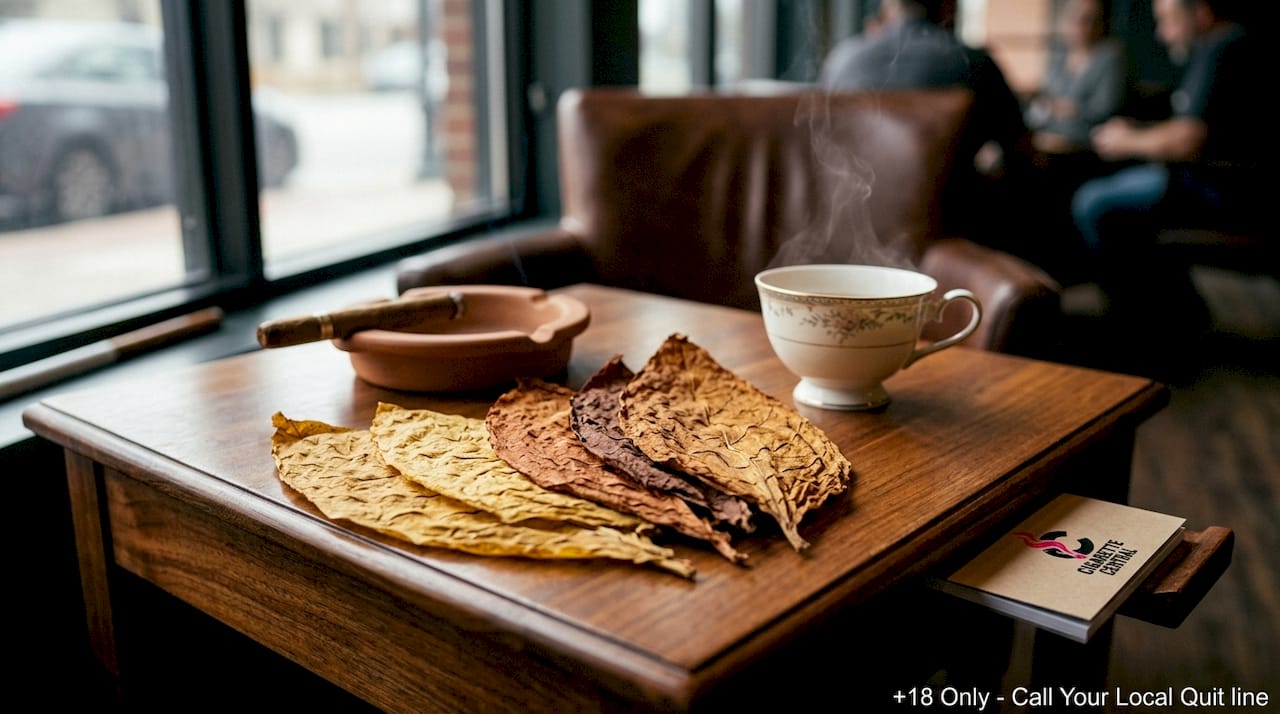
The plant’s sugar and nicotine content varies by stalk position. Lower leaves, called sand lugs, are harvested first and carry the mildest flavour. Upper leaves, called tips, are harvested last and contain the highest nicotine concentration. This variation means a single plant can contribute multiple flavour profiles to a finished blend.
Soil plays a defining role in quality. Sandy, low-nutrient soils produce the classic brightleaf character that Virginia tobacco is known for. Rich, heavy soils push the plant toward coarser growth and a harsher smoke. Soil mineral balance is as influential as genetics in shaping the leaf’s aroma and mildness.
Key Virginia tobacco characteristics at a glance:
- Leaf colour: Pale lemon to deep orange after curing
- Sugar content: 15–25% natural sugars (the highest of any major tobacco type)
- Nicotine content: Moderate, varying by stalk position
- Flavour profile: Mild, sweet, slightly grassy with a clean finish
- Burn quality: Even and consistent, ideal for cigarette manufacturing
- Soil preference: Sandy, well-drained, low-nutrient soils
Pro Tip: If you are growing Virginia tobacco at home, resist the urge to fertilise heavily. Nutrient-rich soil produces a harsher leaf. Less is genuinely more when it comes to soil inputs for brightleaf quality.
How is Virginia tobacco cured and processed?
Flue-curing is the defining process that transforms a green Virginia tobacco leaf into the bright, sweet product used in cigarette blends. The process takes place in an enclosed curing barn where hot air circulates without any smoke contact. Temperatures run at 60–75°C for 4–7 days, carefully managed in stages to control the biochemical changes inside the leaf.
The curing process follows a clear sequence:
- Yellowing stage: Temperature is held low (around 35–40°C) to allow the leaf’s chlorophyll to break down. Enzymes convert starches into simple sugars during this phase.
- Colour fixing stage: Temperature rises to around 55°C to halt enzyme activity and lock the yellow-orange colour in place.
- Leaf drying stage: Heat increases further to dry the leaf blade while preserving the fixed sugars.
- Stem drying stage: The highest temperatures (up to 75°C) dry the midrib of the leaf completely.
The bright yellow-orange colour that Virginia tobacco is famous for results directly from precise heat management during the yellowing stage. Many people assume the colour comes from fermentation. It does not. The colour is fixed by halting leaf metabolism at exactly the right moment. Mismanage the temperature and the leaf turns brown, losing both colour and sweetness.
| Curing stage | Temperature range | Purpose |
|---|---|---|
| Yellowing | 35–40°C | Starch-to-sugar conversion |
| Colour fixing | 50–55°C | Halt enzyme activity, lock colour |
| Leaf drying | 55–65°C | Remove moisture from blade |
| Stem drying | 65–75°C | Dry midrib completely |
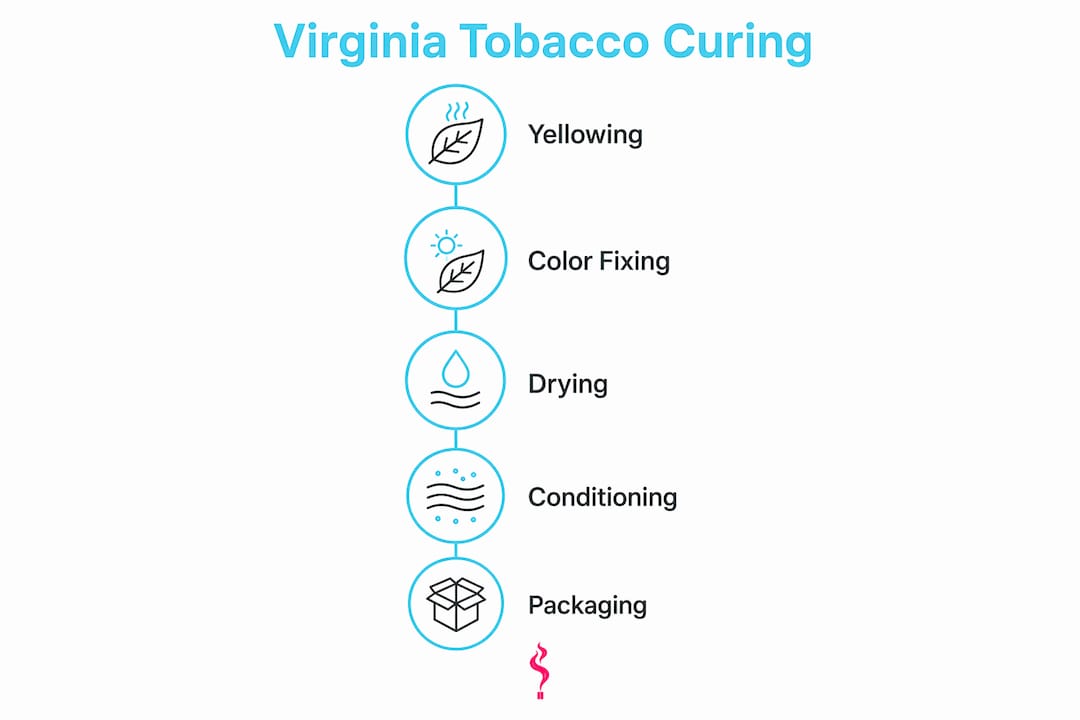
After curing, the leaves are brittle and fragile. Post-curing conditioning involves carefully reintroducing moisture to make the leaves pliable enough for rolling or blending. Skip this step and the leaves crack and crumble during processing. Leaves are then graded by stalk position and colour before being sold to manufacturers or blenders.
Pro Tip: When assessing cured Virginia leaf quality, look for a uniform golden colour with no brown patches. Brown areas indicate temperature spikes during curing that destroyed the sugars and damaged the leaf’s flavour potential.
What makes Virginia tobacco unique compared to other tobacco types?
Virginia tobacco’s defining advantage is its high natural sugar content, which gives it a mild, sweet base flavour that other tobacco types cannot replicate without added casing. Burley tobacco, by contrast, contains less than 1% natural sugar and is air-cured, which makes it porous and ideal for absorbing flavour additives. Virginia does not need additives to taste good. That is a meaningful distinction in commercial blending.
| Tobacco type | Sugar content | Curing method | Flavour profile | Primary use |
|---|---|---|---|---|
| Virginia | 15–25% | Flue-cured | Mild, sweet, bright | Cigarette base leaf |
| Burley | Less than 1% | Air-cured | Earthy, nutty, dry | Flavour absorption blends |
| Oriental | 10–15% | Sun-cured | Spicy, aromatic | Blend complexity |
| Rustica | Variable | Various | Strong, harsh | Specialist and traditional use |
Virginia tobacco comprises 50–70% of most commercial cigarette blends worldwide. That proportion reflects its role as a neutral, consistent carrier that holds a blend together without overpowering other components. Blenders add Burley for body and Oriental for aroma, but Virginia provides the foundation.
A few common misconceptions are worth clearing up:
- “Red Virginia” is a distinct botanical variety. It is not. The term refers to a cured leaf colour or a specific heat profile during curing, not a separate plant species. American grading standards based on stalk position are the recognised international standard for classification.
- Bright colour means fermentation. Incorrect. The golden colour is a product of flue-curing temperature control, not fermentation.
- All Virginia tobacco tastes the same. Leaf position, soil type, and curing precision all produce meaningful flavour differences within the Virginia category.
For a practical comparison of how Virginia performs against other loose tobacco options available in Australia, the loose tobacco comparison guide at Cigarettecentral covers the key differences in detail.
What is the historical significance of Virginia tobacco?
Virginia tobacco originates from colonial North America, where English settlers in the Virginia colony began cultivating Nicotiana tabacum in the early 17th century. The leaf became the economic backbone of the colony and, eventually, the foundation of the modern global tobacco industry. Flue-curing was developed in the American South during the 19th century, and it transformed Virginia tobacco from a rustic crop into a precision product suited for industrial cigarette manufacturing.
The leaf’s global spread followed trade routes and colonial expansion. By the 20th century, Virginia tobacco was grown commercially across Africa, Asia, and parts of South America, with Zimbabwe, Brazil, and India becoming major producers alongside the United States.
Australia’s relationship with Virginia tobacco production tells a more complicated story:
- Domestic tobacco growing was attempted in several Australian states, including Queensland and Victoria, through the 19th and 20th centuries.
- Australian producers struggled to compete with imported American Virginia leaf due to inconsistent curing practices and a lack of industrial-scale curing infrastructure.
- The cost of replicating the precise flue-curing conditions required for quality brightleaf made domestic production uneconomical at scale.
- Australian tobacco farming declined significantly through the latter half of the 20th century, and the country now relies almost entirely on imported leaf for its tobacco products.
“Australia’s difficulty in competing domestically highlights the importance of industrial-scale flue-curing for producing market-quality Virginia tobacco. Without consistent temperature control across large curing barns, the leaf’s defining sweetness and colour simply cannot be achieved reliably.”
Virginia tobacco’s legacy in Australia is felt through consumption rather than production. Brands built on Virginia leaf blends remain among the most popular choices for Australian smokers, and understanding the leaf’s origins helps you appreciate what you are actually smoking. If you want to understand how tobacco origin shapes flavour, the sourcing story behind Virginia leaf is one of the most instructive examples in the industry.
Virginia tobacco products: what’s available for Australian smokers?
Australian smokers have access to a range of products built on Virginia tobacco blends, from loose roll-your-own options to manufactured cigarettes. Golden Virginia is the most recognised brand name associated with this leaf type in Australia. It is worth knowing that “Golden Virginia” refers to a specific product line, not a distinct tobacco variety. The underlying leaf is still flue-cured Virginia brightleaf.
For smokers in Sydney, Melbourne, Brisbane, and Perth who prefer roll-your-own options, Golden Virginia Japanese Premium Loose Tobacco 100g is a well-regarded choice that showcases the classic mild, sweet character of quality Virginia leaf. Smokers in Adelaide and Hobart who prefer manufactured cigarettes will find Virginia-based blends across multiple price points at Cigarettecentral.
For those comparing loose tobacco options, the Golden Virginia vs White Ox vs Drum comparison provides a practical breakdown of how Virginia-based products perform against other popular Australian choices.
Customer story
“I had been smoking the same brand for years without really knowing what was in it. After reading about Virginia tobacco and flue-curing, I tried a pure Virginia loose tobacco for the first time. The difference in sweetness and smoothness was obvious. I ordered through Cigarettecentral and had it delivered to my door in Brisbane within a few days. Now I actually understand what I am buying.” — Mark T., Brisbane, QLD
Key takeaways
Virginia tobacco is the world’s most widely grown flue-cured leaf, defined by its high natural sugar content, bright colour, and mild flavour that forms the base of most commercial cigarette blends globally.
| Point | Details |
|---|---|
| Global production share | Virginia tobacco accounts for approximately 40% of global tobacco production. |
| Sugar content advantage | Natural sugar levels of 15–25% give Virginia its mild, sweet flavour without additives. |
| Flue-curing is critical | Precise heat management at 60–75°C over 4–7 days defines the leaf’s colour and sweetness. |
| Blend composition | Virginia leaf makes up 50–70% of most commercial cigarette blends worldwide. |
| Australian context | Australia relies on imported Virginia leaf due to historical challenges with industrial-scale curing. |
What I have learned from years of watching people misread Virginia tobacco
Most smokers think of tobacco as a single, undifferentiated product. Virginia tobacco proves that assumption wrong in every measurable way. The curing process alone involves more precision than most people apply to cooking a meal. Temperature deviations of even 5°C at the wrong stage can ruin an entire barn of leaf.
The thing that surprises people most is how much the soil matters. You can plant the same Virginia seed in two different paddocks and get dramatically different results. Sandy, mineral-light soils produce the classic brightleaf character. Heavier soils produce a coarser, harsher leaf that no amount of careful curing can fully correct. Genetics set the ceiling, but soil and curing determine whether you reach it.
The grading terminology also trips people up. “Red Virginia” sounds like a distinct variety, but it is simply a descriptor for cured leaf colour or a heat profile. American stalk-position grading, which runs from sand lugs at the bottom to tips at the top, is the internationally recognised standard. Knowing this helps you read product descriptions and blend specifications with far more confidence.
My practical advice for Australian smokers who want to appreciate Virginia tobacco properly: start with a quality loose Virginia product and smoke it without mixing. The clean, slightly grassy sweetness with a smooth finish is the benchmark. Once you know what pure Virginia tastes like, you will immediately recognise its presence or absence in any blend you try.
— Cigarettecentral
Virginia tobacco blends available at Cigarettecentral
Cigarettecentral stocks a range of tobacco products built on quality Virginia leaf blends, from loose roll-your-own options to manufactured cigarettes across multiple price points.

Whether you prefer the classic mild character of a pure Virginia loose tobacco or the convenience of a manufactured cigarette with a Virginia-forward blend, the full tobacco collection at Cigarettecentral covers both. Orders ship within 2–5 business days with discreet packaging, and the site offers 24/7 customer support for any questions about product selection. For smokers across Australia looking for quality Virginia-based products at competitive prices, Cigarettecentral is a practical and reliable option.
FAQ
What is Virginia tobacco?
Virginia tobacco is a flue-cured variety of Nicotiana tabacum with a natural sugar content of 15–25%, giving it a mild, sweet flavour. It accounts for approximately 40% of global tobacco production and forms the base of most commercial cigarette blends.
How does Virginia tobacco differ from Burley tobacco?
Virginia tobacco is flue-cured and contains 15–25% natural sugar, producing a mild, sweet flavour. Burley tobacco is air-cured and contains less than 1% sugar, making it earthy and porous, which is why blenders use it to absorb flavour additives.
Why is flue-curing important for Virginia tobacco?
Flue-curing at 60–75°C over 4–7 days converts starches to sugars and fixes the leaf’s bright colour by halting metabolism at the optimal stage. Without precise temperature control, the leaf loses both its golden colour and its characteristic sweetness.
Is Virginia tobacco good for roll-your-own smoking?
Virginia tobacco is well-suited to roll-your-own use because of its even burn, mild flavour, and consistent texture after conditioning. Products like Golden Virginia loose tobacco are specifically designed for this purpose and are widely available in Australia.
What does “Red Virginia” mean?
“Red Virginia” is not a distinct botanical variety. The term describes a cured leaf colour or a specific heat profile used during flue-curing. International grading standards classify Virginia tobacco by stalk position, from sand lugs at the base to tips at the top of the plant.


