





TL;DR:
- Pipe tobacco is distinguished by its coarser cut, higher moisture content, and minimal additives, making it different from cigarettes in form and effect. It offers a slower, flavor-focused smoking experience with different health and regulatory considerations compared to the fast, additive-rich cigarette smoking method. Substituting between the two is ineffective, and understanding their physical, chemical, and legal differences helps smokers make informed choices.
Pipe tobacco is defined by its coarser cut, higher moisture content, and minimal chemical additives, making it fundamentally different from cigarette tobacco in both form and function. Understanding how pipe tobacco differs from cigarettes matters for any smoker making an informed choice about their experience, their wallet, and their health. Cigarette tobacco is finely shredded, intentionally dried, and treated with hundreds of additives to control burn rate and nicotine delivery. In Australia, the two product types are also taxed differently, with excise rates set at $1.52829 per cigarette and $2,445.26 per kilogram for loose tobacco including pipe tobacco as of march 2026. These differences shape everything from flavour to cost to the ritual of smoking itself.
How pipe tobacco differs from cigarettes physically and chemically
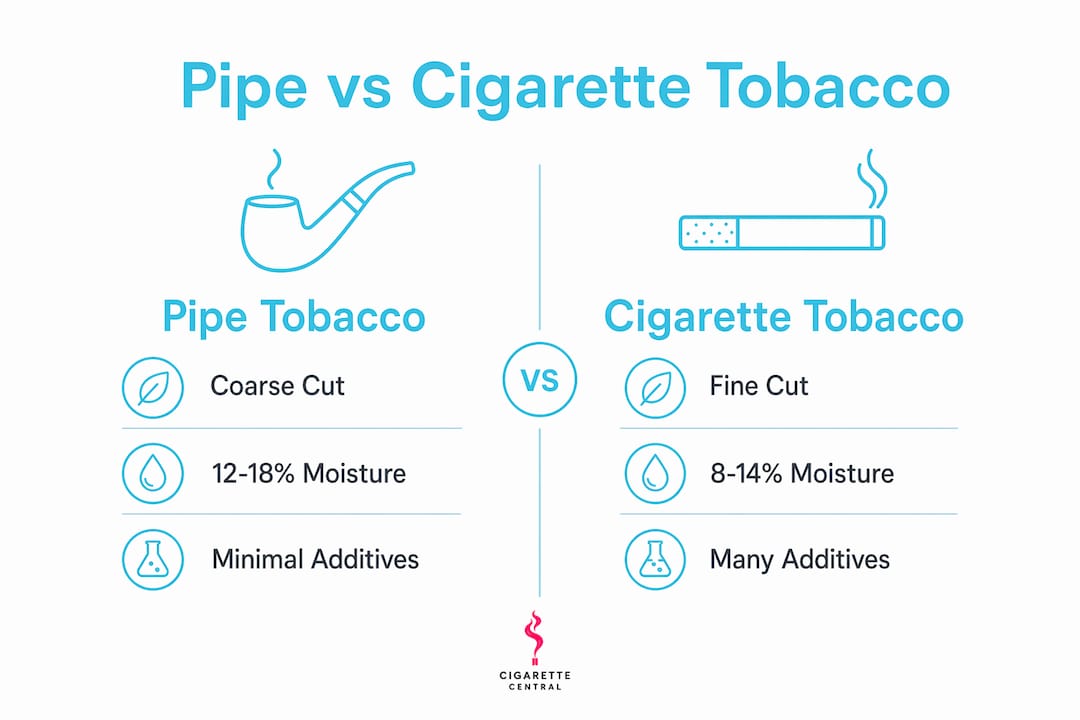
The most immediate difference between pipe tobacco and cigarette tobacco is the cut. Pipe tobacco uses coarser cuts such as ribbon, flake, and plug, while cigarette tobacco is uniformly shredded into fine strands. That difference in cut directly affects how each burns and how much heat it produces.
Moisture content is the second major distinction. Pipe tobacco retains 12–18% moisture, while cigarette tobacco sits at 6–9%. Higher moisture in pipe tobacco slows combustion, producing a cooler, smoother smoke. Cigarette tobacco is intentionally dry so it burns fast and evenly with every puff.
The chemical additive gap is striking. Cigarette tobacco contains hundreds of additives engineered to control burn rate, enhance nicotine delivery, and extend shelf life. Pipe tobacco uses minimal additives, preserving the natural flavour of the leaf. That is why pipe smokers often describe their smoke as tasting of the tobacco itself rather than a processed product.
Here is a direct comparison of the key physical and chemical attributes:
| Attribute | Pipe tobacco | Cigarette tobacco |
|---|---|---|
| Cut style | Ribbon, flake, plug | Fine, uniform shreds |
| Moisture content | 12–18% | 6–9% |
| Chemical additives | Minimal | Hundreds |
| Burn rate | Slow, cool | Fast, hot |
| Flavour profile | Natural, complex | Processed, consistent |
Pro Tip: Store pipe tobacco in a sealed container with a humidity regulator to keep moisture between 12–18%. Too dry and the smoke turns harsh; too moist and the tobacco will not stay lit.
How do smoking methods differ between pipe tobacco and cigarettes?
The smoking ritual separates pipe tobacco and cigarettes as much as the tobacco itself does. Pipe smokers typically do not inhale. The smoke is drawn into the mouth, held briefly, and exhaled, with nicotine absorbed through the oral mucosa rather than the lungs. Cigarette smokers inhale deeply into the lungs for rapid nicotine delivery.
Smoke pH drives this difference. Pipe smoke is alkaline, which allows nicotine to be absorbed efficiently through the lining of the mouth. Cigarette smoke is acidic, which limits oral absorption and makes lung inhalation necessary for the same nicotine effect. This is not a minor chemistry detail. It explains why the two products are designed, marketed, and consumed so differently.
The experience of smoking also differs in pace and purpose:
- Pipe smoking is slow and contemplative. A single bowl can last 30–60 minutes. The focus is on flavour appreciation and ritual.
- Cigarette smoking is quick. A cigarette is typically finished in 5–10 minutes. The focus is on rapid nicotine delivery.
- Nicotine absorption in pipe smoking is gradual and oral. In cigarette smoking it is fast and pulmonary.
- Tar delivery differs too. Because pipe smokers do not inhale, tar exposure to the lungs is lower, though mouth and throat exposure remains a health concern.
Pipe tobacco is curated for a ritualistic, flavour-focused experience, while cigarette tobacco is engineered for rapid nicotine delivery and consistent addictiveness. That engineering difference is visible in every aspect of how each product is made and used.
What are the health and regulatory differences in Australia?
Australia applies some of the world’s strictest tobacco regulations to both pipe tobacco and cigarettes. Australian excise duty is indexed biannually to wage growth, meaning prices rise steadily regardless of market conditions. The policy intent is clear: make tobacco expensive enough to reduce consumption across all product types.
As of march 2026, the excise structure looks like this:
| Product type | Excise rate |
|---|---|
| Cigarettes | $1.52829 per stick |
| Loose tobacco (including pipe) | $2,445.26 per kilogram |
Excise taxes make up around 70–75% of the retail price of tobacco products in Australia. That means the price you pay at the counter is overwhelmingly tax, not product cost.
Australian law mandates plain packaging in a standardised brown colour with prominent health warnings and tightly restricted brand text for all tobacco products, including pipe tobacco and roll-your-own tobacco. There is no exemption for premium or specialty pipe tobacco products.
High excise taxes combined with plain packaging laws are effective public health tools in Australia, reducing tobacco consumption across all types including pipe tobacco and cigarettes.
The health risk profiles of the two products differ based on smoking method. Pipe smokers who do not inhale avoid direct lung tar exposure, but face elevated risks of mouth, lip, and throat cancers. Cigarette smokers face lung cancer, cardiovascular disease, and chronic obstructive pulmonary disease as primary risks. Neither product is safe. The risks are different in location and mechanism, not in severity.
Smokers in Perth, Adelaide, and Hobart report that rising excise costs have pushed them to reconsider their tobacco choices, with some shifting toward pipe tobacco for its longer smoking duration per gram. Understanding tobacco pricing in Australia helps you make a more cost-aware decision.
Can you use pipe tobacco in cigarettes, and vice versa?
The short answer is no, not effectively. Using pipe tobacco in rolled cigarettes causes uneven burning and a harsh, wet taste because the moisture content and cut size are wrong for the format. The tobacco does not draw cleanly through a cigarette tube and tends to clog or burn inconsistently.
Cigarette tobacco in a pipe creates the opposite problem. It burns too hot and too fast, producing a harsh, acrid smoke that overwhelms the pipe bowl. The fine cut means it packs too tightly and restricts airflow, making the smoke difficult to draw.
If you want to attempt substitution, here is what actually happens at each step:
- Pipe tobacco in a cigarette: The high moisture content makes rolling difficult. The tobacco clumps and does not distribute evenly. Even if you roll it successfully, the burn is uneven and the taste is harsh.
- Drying pipe tobacco for rolling: Some smokers dry pipe tobacco to reduce moisture before rolling. This can improve burn consistency, but the coarser cut still causes draw resistance and flavour issues.
- Cigarette tobacco in a pipe: The fine cut packs too densely. Airflow is restricted. The tobacco burns hot and fast, scorching the bowl and producing a bitter, unpleasant smoke.
- The flavour result: Neither substitution produces the flavour the tobacco was designed to deliver. You lose the slow, cool burn of pipe tobacco and the consistent draw of a cigarette.
Pro Tip: If you are curious about pipe smoking but only have cigarette tobacco on hand, do not bother testing it in a pipe. The experience will put you off pipe smoking entirely. Start with a tobacco cut designed for pipes.
What should you consider when choosing between pipe tobacco and cigarettes?
Choosing between pipe tobacco and cigarettes comes down to four practical factors: cost per session, flavour preference, time commitment, and social context.
Cost per session is not straightforward. Pipe tobacco costs more per kilogram in excise terms, but a single bowl uses far less tobacco than a pack of cigarettes delivers over the same period. For heavy smokers in Sydney or Melbourne, the maths often favours pipe tobacco for daily use. You can explore cigarette price comparisons to see how the numbers stack up in your city.
Flavour profiles differ dramatically. Pipe tobacco comes in aromatic blends with notes of vanilla, cherry, and cavendish, as well as natural English and Virginia blends with grassy, earthy complexity. Cigarette tobacco delivers a consistent, processed flavour that varies mainly by strength and blend type.
Consider these factors when making your choice:
- Time available: Pipe smoking takes 30–60 minutes per session. Cigarettes take 5–10 minutes. If you smoke on work breaks, cigarettes are more practical.
- Skill and equipment: Pipe smoking requires a pipe, tamper, and some technique to pack and light correctly. Cigarettes require no equipment beyond a lighter.
- Social setting: Cigarettes are socially familiar across Australia. Pipe smoking is less common and draws more attention in public spaces.
- Flavour priority: If flavour complexity matters to you, pipe tobacco offers far more variety and nuance. If consistency and speed matter more, cigarettes deliver that reliably.
Smokers in Brisbane and Darwin who have made the switch to pipe tobacco often cite the slower pace and richer flavour as the deciding factors. For those who want guidance on choosing between tobacco types, the decision is personal but informed by these practical differences.
Customer story
Mark, a smoker from Newcastle, switched from cigarettes to pipe tobacco after 12 years. “I was spending a fortune on cigarettes and not really enjoying them anymore,” he says. “With pipe tobacco, I smoke less often, I actually taste what I’m smoking, and I feel like I’m getting value for money. The ritual of packing and lighting a pipe made me slow down. That was the biggest surprise.”
His experience reflects what many Australian smokers discover when they make the switch: the differences between pipe tobacco and cigarettes are not just technical. They change how you relate to smoking itself.
Key takeaways
Pipe tobacco and cigarette tobacco are fundamentally different products in cut, moisture, additives, smoke chemistry, and intended smoking method, and choosing between them requires understanding all five dimensions.
| Point | Details |
|---|---|
| Cut and moisture | Pipe tobacco uses coarser cuts and 12–18% moisture; cigarette tobacco is finely shredded at 6–9% moisture. |
| Chemical additives | Cigarette tobacco contains hundreds of additives; pipe tobacco uses minimal processing to preserve natural flavour. |
| Smoke chemistry | Pipe smoke is alkaline for oral nicotine absorption; cigarette smoke is acidic and requires lung inhalation. |
| Australian excise | As of march 2026, excise is $1.52829 per cigarette and $2,445.26 per kilogram for loose tobacco. |
| Interchangeability | Pipe tobacco and cigarette tobacco are not interchangeable; substitution produces poor burn quality and harsh flavour. |
What I have learned from years in Australian tobacco retail
The question I hear most from smokers is whether pipe tobacco is “better” than cigarettes. My honest answer is that it depends entirely on what you want from smoking. Pipe tobacco is not a shortcut to a cheaper or healthier habit. It is a different habit with its own demands, rewards, and costs.
What surprises most people is how much the ritual matters. Pipe smoking forces you to slow down. You pack the bowl, you light it carefully, you tamp and relight. That process changes your relationship with tobacco in a way that cigarettes simply do not. Whether that is a benefit or an inconvenience depends on your personality and your schedule.
The excise structure in Australia also deserves more attention than it gets. The per-kilogram rate for loose tobacco sounds alarming until you calculate how many sessions you get from 50 grams of pipe tobacco versus a carton of cigarettes. For some smokers, particularly those in regional areas like Cairns or Ballarat where convenience stores charge premium prices, pipe tobacco works out significantly cheaper per hour of smoking.
My practical advice: if you are curious about pipe tobacco, buy a small quantity of a ribbon-cut Virginia blend and a basic pipe before committing. Do not start with an aromatic blend. The flavour is stronger and the moisture is often higher, which makes it harder to keep lit while you are still learning technique. Get the basics right first, then explore the full range of cuts and blends.
Understanding the differences between pipe tobacco and cigarettes does not just make you a more informed shopper. It makes you a more deliberate smoker, and that awareness is worth something regardless of which product you choose.
— Cigarettecentral
Tobacco products worth exploring at Cigarettecentral
Cigarettecentral stocks a curated range of tobacco products suited to both pipe smokers and cigarette smokers across Australia, with fast shipping of 2–5 business days and discreet packaging on every order. Whether you are looking for a quality loose tobacco for rolling or a premium cigarette brand, the full tobacco collection covers a wide range of options at competitive prices. For those who prefer a ready-made cigarette experience, Davidoff Gold Cigarettes offer a smooth, consistent blend available in bulk packs. Cigarettecentral also runs regular sales with savings of up to 30%, and the best current offers are updated frequently. Secure payment processing and 24/7 customer support make every purchase straightforward.
FAQ
What is the main difference between pipe tobacco and cigarette tobacco?
Pipe tobacco uses coarser cuts and retains 12–18% moisture for slow, cool combustion, while cigarette tobacco is finely shredded, drier at 6–9% moisture, and contains hundreds of chemical additives for fast, consistent burning.
Do pipe smokers inhale smoke like cigarette smokers?
Pipe smokers typically do not inhale. Pipe smoke is alkaline, allowing nicotine to absorb through the oral mucosa, whereas cigarette smoke is acidic and requires lung inhalation for effective nicotine delivery.
How does Australian excise tax apply to pipe tobacco versus cigarettes?
As of march 2026, cigarettes attract excise of $1.52829 per stick, while loose tobacco including pipe tobacco is taxed at $2,445.26 per kilogram, with taxes making up around 70–75% of the retail price for both product types.
Can you use pipe tobacco to roll cigarettes?
Using pipe tobacco in rolled cigarettes is not recommended. The higher moisture content and coarser cut cause uneven burning, draw resistance, and a harsh taste that makes the cigarette difficult to smoke.
Is pipe tobacco subject to plain packaging laws in Australia?
Yes. Australian plain packaging laws apply to all tobacco products including pipe tobacco, requiring standardised brown packaging with prominent health warnings and tightly restricted brand text.


