





TL;DR:
- Calculating the true cost per cigarette helps smokers find better value in Australia’s high-priced tobacco market.
- To do this, divide the total purchase price, including fees, by the number of cigarettes in the pack or carton.
Cigarette price comparison is the process of calculating and contrasting the cost per cigarette across different brands, pack sizes, and purchase methods to identify the best value available. Australia is one of the world’s most expensive countries for tobacco, with average pack prices sitting between $55 and $70 AUD. Excise tax accounts for roughly 75% of that retail price, which means the gap between a smart purchase and a careless one is significant. Understanding what is cigarette price comparison, and how to do it properly, puts real money back in your pocket.
What is cigarette price comparison and why does it matter?
Cigarette price comparison is defined as the systematic evaluation of tobacco costs across brands, pack sizes, retailers, and purchase formats to find the lowest cost per cigarette. The industry term for this practice is unit cost analysis, and it is the same method used by consumer advocates and public health researchers to track tobacco affordability. Simply looking at the sticker price on a pack tells you very little. A $60 pack of 25 cigarettes costs $2.40 per cigarette, while a $55 pack of 20 costs $2.75 per cigarette. The cheaper pack is actually more expensive per smoke.

This distinction matters because Australian cigarette prices are roughly double those in Canada and far higher than most European and US markets. At that price level, even a small difference in cost per cigarette adds up to hundreds of dollars over a year. Cigarette price analysis is not just a habit for bargain hunters. It is a practical financial skill for any regular smoker in Australia.
How to calculate the true cost per cigarette
The most accurate comparison method is straightforward: divide the total price by the number of cigarettes in the pack or carton. This single figure, the cost per cigarette, cuts through the noise of different pack sizes and upfront costs.
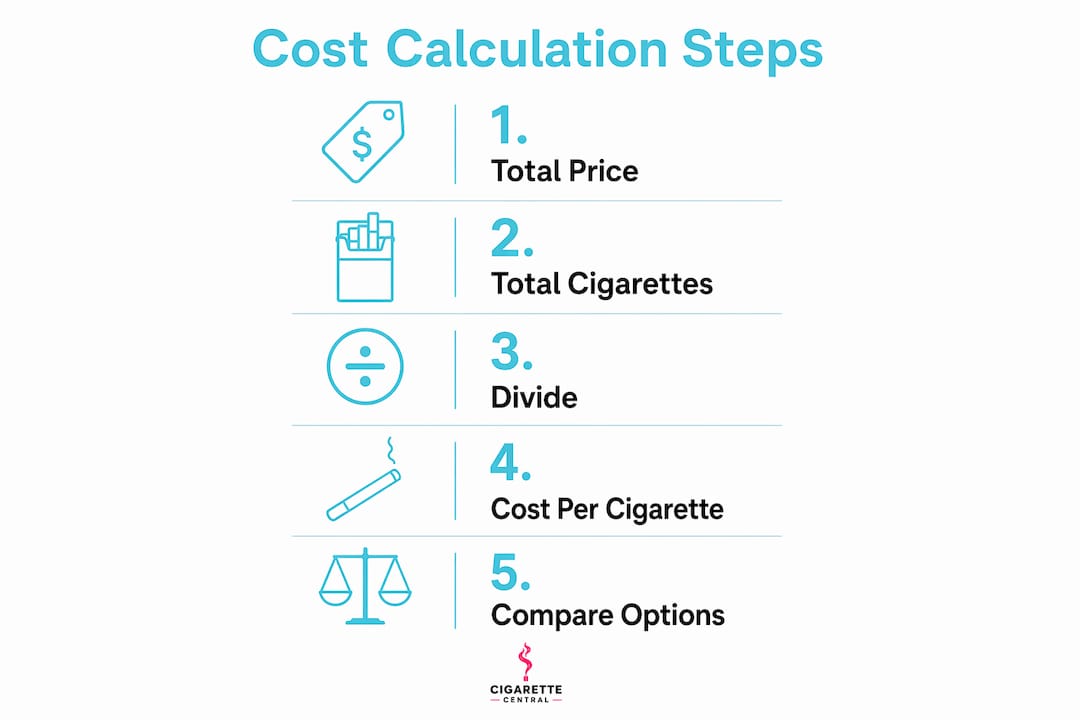
Here is how to apply it step by step:
- Find the total price. Note the full retail price, including any delivery fees if buying online.
- Count the cigarettes. A standard Australian pack contains 20 or 25 cigarettes. A carton typically holds 200 cigarettes across 10 packs.
- Divide price by quantity. Total price ÷ number of cigarettes = cost per cigarette.
- Compare across options. Run the same calculation for every product you are considering, then rank them from lowest to highest cost per cigarette.
- Factor in shipping. For online purchases, add the delivery fee to the total price before dividing. A $5 shipping fee on a $55 pack raises your cost per cigarette by $0.25.
A practical example: a carton of 200 cigarettes priced at $380 works out to $1.90 per cigarette. A single pack of 25 at $65 works out to $2.60 per cigarette. The carton saves you $0.70 per cigarette, which equals $140 saved per 200 cigarettes.
Pro Tip: Always run the cost per cigarette calculation before you buy, even when a pack looks cheap at first glance. Pack size differences make direct price comparisons misleading every time.
What factors affect cigarette prices in Australia beyond the sticker price?
Several forces push the final cost of cigarettes well above the shelf price. Knowing each one helps you compare accurately.
- Excise tax. Excise tax makes up approximately 75% of the retail price of cigarettes in Australia. This is a government levy applied per cigarette stick, and it increases regularly. Higher excise tax is directly linked to reduced smoking rates, which is why Australia applies it so aggressively.
- Shipping and delivery fees. Online retailers often list attractive base prices, but shipping fees and processing costs can raise the final cart total significantly. Always check the total at checkout, not just the product price.
- Bulk purchase discounts. Online platforms offer volume pricing and bulk discounts that physical retail stores rarely match. Buying a carton instead of individual packs almost always reduces your cost per cigarette.
- Loyalty programmes and sale events. Periodic tobacco sale events and loyalty rewards can reduce your effective price further. Timing your purchase around these events is a legitimate savings strategy.
- Free shipping thresholds. Many online retailers offer free delivery above a minimum order value. Reaching that threshold by buying a carton instead of a single pack can eliminate the shipping cost entirely.
Stat to know: Countries where excise tax exceeds 70% of retail price consistently record the highest cigarette prices and lower smoking prevalence. Australia sits firmly in that category, which is why cigarette cost comparison is more financially valuable here than almost anywhere else in the world.
The practical takeaway is that the price you see listed is rarely the price you pay. Your cigarette price analysis must account for every cost between the product and your door.
How do tobacco industry pricing strategies influence price variations?
Tobacco companies do not simply pass government tax increases on to consumers dollar for dollar. They use deliberate pricing strategies that widen or narrow the gap between premium and budget brands.
Premium brands practise over-shifting: they raise their retail prices by more than the tax increase. This protects their profit margin and reinforces a perception of quality. Budget brands practise under-shifting: they absorb part of the tax increase themselves to keep prices low and hold onto price-sensitive smokers. Research confirms this pattern across multiple markets, where tobacco companies deliberately maintain a wide price gap between premium and lower-priced cigarettes to serve different market segments.
“Tobacco companies use complex pricing strategies: premium brands over-shift tax increases to raise prices beyond government hikes, while low-cost brands under-shift or absorb costs to stay competitive. This maintains a price gap between premium and lower-priced cigarettes.” — PLOS One, tobacco pricing research
What this means for you is that a premium brand costing $70 per pack is not necessarily $20 better than a $50 option. Part of that gap is manufactured by the company’s pricing strategy, not by a genuine difference in product cost. Effective cigarette cost comparison requires you to look past brand positioning and focus on the cost per cigarette metric. A new tobacco brand you have not tried before may deliver comparable quality at a meaningfully lower unit cost.
Practical tips for Australian smokers to find the best cigarette prices
Finding the best cigarette prices in Australia takes a small amount of method. These steps make the process reliable.
- Calculate cost per cigarette first. Never compare two products by pack price alone. Run the unit cost formula on every option before deciding.
- Check the full cart total online. Low base prices online can be misleading when shipping fees and taxes are added. Always view the final checkout total before committing.
- Buy cartons for long-term savings. Carton purchases deliver the lowest cost per cigarette compared to single packs. The upfront cost is higher, but the unit saving is consistent.
- Use online retailers for bulk discounts. Physical retail stores rarely offer volume pricing. Online platforms regularly provide bulk deals and free shipping thresholds that reduce your effective cost.
- Time purchases around sale events. Tobacco sale events offer genuine discounts that compound the savings from bulk buying. Combining a sale with a carton purchase is the most effective way to reduce your cost per cigarette.
- Read brand reviews alongside price. The cheapest cigarette is not the best value if the quality does not suit you. Check product reviews to confirm quality before switching brands purely on price.
Pro Tip: Set a price alert or check your preferred online retailer at the start of each month. Many platforms run monthly promotions that are not advertised widely.
Here is a quick comparison of purchase formats by value:
| Purchase format | Upfront cost | Cost per cigarette | Best for |
|---|---|---|---|
| Single pack (20s) | Low | Highest | Occasional smokers |
| Single pack (25s) | Moderate | Moderate | Regular smokers |
| Carton (200s) | High | Lowest | Daily smokers seeking savings |
| Carton during a sale | High (discounted) | Lowest possible | Maximum long-term savings |
The table makes the logic clear. Daily smokers who buy single packs are paying the highest possible unit cost every time. Switching to cartons, especially during sale periods, is the single biggest lever available for reducing your tobacco spend.
Key takeaways
Cigarette price comparison works by calculating cost per cigarette across brands, pack sizes, and retailers, then factoring in tax, shipping, and bulk discounts to find the true lowest price.
| Point | Details |
|---|---|
| Use cost per cigarette | Divide total price by cigarette count for every option before buying. |
| Factor in all costs | Add shipping fees to the product price before comparing online deals. |
| Buy cartons for savings | Cartons consistently deliver the lowest cost per cigarette versus single packs. |
| Understand industry pricing | Premium brands over-shift tax increases; budget brands absorb them to stay competitive. |
| Time purchases well | Buying during tobacco sale events combined with carton purchases maximises savings. |
My take on cigarette price comparison in Australia
Most smokers I speak with focus entirely on the pack price. They see $55 versus $65 and assume the $55 option is the better deal. That instinct is understandable, but it misses the point almost every time. The pack with 20 cigarettes at $55 costs more per smoke than the pack with 25 at $65. The number that matters is always the cost per cigarette, and most people never calculate it.
The other thing that surprises people is how much the industry shapes what they think is a fair price. Premium brands deliberately raise prices beyond the tax increase. They are not just passing on costs. They are reinforcing a price signal that says “this brand is worth more.” Whether it actually is worth more to you is a separate question. The point is that the price gap between premium and budget cigarettes is partly a marketing decision, not purely a quality one.
Australia’s excise tax environment makes this more urgent than in most countries. When 75% of what you pay goes to the government regardless of which brand you choose, the remaining 25% is where your comparison work actually matters. Online retailers that offer bulk buying benefits and sale pricing are giving you a real tool to work with. Use it deliberately, not just when a deal happens to catch your eye.
The smokers who save the most are not the ones who hunt for the cheapest single pack. They are the ones who understand the cost per cigarette metric, buy in cartons, and time their purchases around promotions. That combination is straightforward once you know what to look for.
— Cigarettecentral
Quality tobacco at prices worth comparing
Cigarettecentral stocks a wide range of tobacco products at discounted prices, with delivery across Australia in 2–5 business days. Whether you prefer cigarettes or loose tobacco, the range covers popular brands at rates that hold up well under a cost per cigarette analysis.

Bulk orders attract genuine volume discounts, and the tobacco collection includes options at multiple price points so you can compare directly before buying. Secure payment processing and discreet packaging are standard on every order. Cigarettecentral also runs regular sale events where savings of up to 30% are available, making it a practical first stop for Australian smokers who take their cigarette cost comparison seriously.
FAQ
What is cigarette price comparison?
Cigarette price comparison is the process of calculating the cost per cigarette across different brands, pack sizes, and retailers to identify the best value. It goes beyond comparing pack prices and accounts for unit cost, shipping fees, and bulk discounts.
How do I calculate cost per cigarette?
Divide the total purchase price, including any delivery fees, by the total number of cigarettes. This gives you the cost per cigarette, which is the most reliable metric for comparing any two products.
Why are cigarettes so expensive in Australia?
Excise tax accounts for approximately 75% of the retail price of cigarettes in Australia. This government levy applies per cigarette stick and increases regularly, making Australia one of the most expensive tobacco markets in the world.
Are cartons cheaper than single packs?
Yes. Carton purchases consistently deliver a lower cost per cigarette than buying individual packs. The upfront cost is higher, but the unit saving is significant, especially for daily smokers.
Do online cigarette prices include all costs?
Not always. Base prices listed online often exclude shipping fees and processing charges. Always check the final cart total before comparing an online price to an in-store price or another retailer’s offer.


