











Light smokers on 5 to 10 cigarettes a day typically spend $35 to $90 a week, average smokers on 13 to 15 a day sit around $91 to $165, and pack-a-day smokers pay roughly $280 to $350, based on $40 to $50 packs of 20. The formula is simple: (cigarettes per day ÷ 20) × pack price × 7. Prices also creep up every year because excise is indexed twice, on March 1 and September 1.
TL;DR:
- Small weekly savings from reducing daily cigarettes include about $26 if you cut from 20 to 15 cigarettes, and around $52 if you drop to 10, based on a $45 pack.
- Buying loose tobacco in bulk or choosing budget-friendly factory packs can significantly lower weekly tobacco expenses compared to single-pack purchases.
- Excise and taxes constitute approximately 70 to 75% of retail cigarette prices in Australia, causing costs to increase twice yearly and making price differences primarily driven by tax policy.
- Vaping can reduce weekly costs only if it leads to a genuine decrease in cigarette consumption, as device and liquid expenses may offset savings for heavy vapers.
Table of Contents
- How to calculate your personal weekly smoking cost (step-by-step)
- Typical weekly cost ranges and what drives the difference (tax, pack price, consumption)
- Practical ways Australians reduce weekly tobacco spend
- Cigarette Central’s product range for managing weekly spend
- How much do vapes and e-cigarettes change weekly smoking-related costs?
- Does where you live in Australia change your weekly smoking cost?
- What does smoking cost beyond the weekly figure?
- What smokers actually say about switching formats
- Get your weekly spend under control with Cigarette Central
- Sources
- FAQ
How to calculate your personal weekly smoking cost (step-by-step)
Working out your own number takes thirty seconds once you know the formula. It’s the same maths the Quitline cost calculator and the Heart Foundation’s calculator use behind the scenes.
- Divide your daily cigarette count by 20 to get packs per day.
- Multiply that by your pack price to get your daily spend.
- Multiply the daily figure by 7 for your weekly total.
Worked example 1: Ten cigarettes a day at $45 for a pack of 20. That’s (10 ÷ 20) × $45 = $22.50 a day, or $157.50 a week.
Worked example 2: A full pack a day, 20 cigarettes, at $50. That’s (20 ÷ 20) × $50 = $50 a day, or $350 a week.
Loose tobacco needs an extra step, because you’re buying by weight, not by stick. A conservative planning assumption is around 0.7 grams of tobacco per roll-your-own cigarette, which avoids overstating how much you’ll save by switching formats. To find your weekly cost:
- Divide your pouch price by the pouch weight in grams to get a price per gram.
- Multiply that by 0.7 to get an estimated cost per cigarette.
- Multiply by how many you smoke a day, then by 7.
A $60 pouch of 200g tobacco works out to $0.30 a gram. At 0.7g a cigarette, that’s roughly $0.21 per stick, well under most factory-made packs. Rolling tighter cigarettes pushes the saving further; rolling loose ones erodes it fast.
Typical weekly cost ranges and what drives the difference (tax, pack price, consumption)
Tax is the biggest single lever on your weekly bill. Excise and GST together typically make up 70 to 75% of the retail price of a pack of cigarettes in Australia, which means most of what you pay isn’t the product at all.
By the numbers: A pack-a-day habit costs about $280 a week at $40 a pack, or $350 a week at $50 a pack — a $70 weekly swing from a $10 difference in pack price.
From 1 September 2026, the excise rate sits at $1.55274 per stick and $2,587.90 per kilogram of loose tobacco content. That rate isn’t fixed. It moves twice a year, on March 1 and September 1, tracking average wage growth, so your weekly spend drifts upward even if you smoke exactly the same number of cigarettes.
Small changes compound quickly:
- Dropping from 20 to 15 cigarettes a day at $45 a pack saves about $26.25 a week.
- A $5 jump in pack price on a pack-a-day habit adds $35 a week, or roughly $1,820 a year.
- Switching from $50 packs to $40 packs without changing consumption saves $70 a week outright.
None of this is random. It’s built into how excise is calculated and indexed, and it’s the reason your weekly tobacco budget rarely stays flat for long.
Practical ways Australians reduce weekly tobacco spend
Cutting your weekly bill doesn’t have to mean quitting outright, though quitting is obviously the biggest saving available. Most smokers who bring their weekly spend down do it through a mix of smaller, practical choices.
- Cut daily consumption gradually. Dropping from 20 to 15 cigarettes a day saves roughly $26 a week at $45 a pack; dropping to 10 saves around $52.
- Switch some or all consumption to loose tobacco. Using the 0.7g-per-cigarette assumption, well-rolled RYO cigarettes can cost well under half of an equivalent factory-made stick, though loose tobacco carries a heavy per-kilogram excise rate, so the saving only holds if you’re disciplined about roll size.
- Buy in bulk where it makes sense. Larger pouches and multipack cartons generally bring the per-cigarette or per-pack cost down compared to buying single packs.
- Shop with a reputable online retailer. Fast, reliable shipping and discreet packaging matter when you’re ordering bulk pouches or cartons, and buying cheap cigarettes online from a legitimate Australian seller can beat convenience-store pricing without the guesswork.
- Choose value-brand packs for everyday smoking. Reserving premium brands for occasional use and defaulting to a budget-friendly blend day to day keeps weekly costs down without cutting cigarette count.
Pro Tip: *Track your actual weekly spend for two weeks using your bank statement or receipts before you try any cost-cutting strategy.
One caveat worth stating plainly: stick to lawful, licensed sellers. Illicit tobacco might look cheaper on paper, but it carries no quality guarantees and real legal risk.
Cigarette Central’s product range for managing weekly spend
If you’re comparing formats to see what actually lowers your weekly number, Cigarette Central’s range gives you three practical starting points.
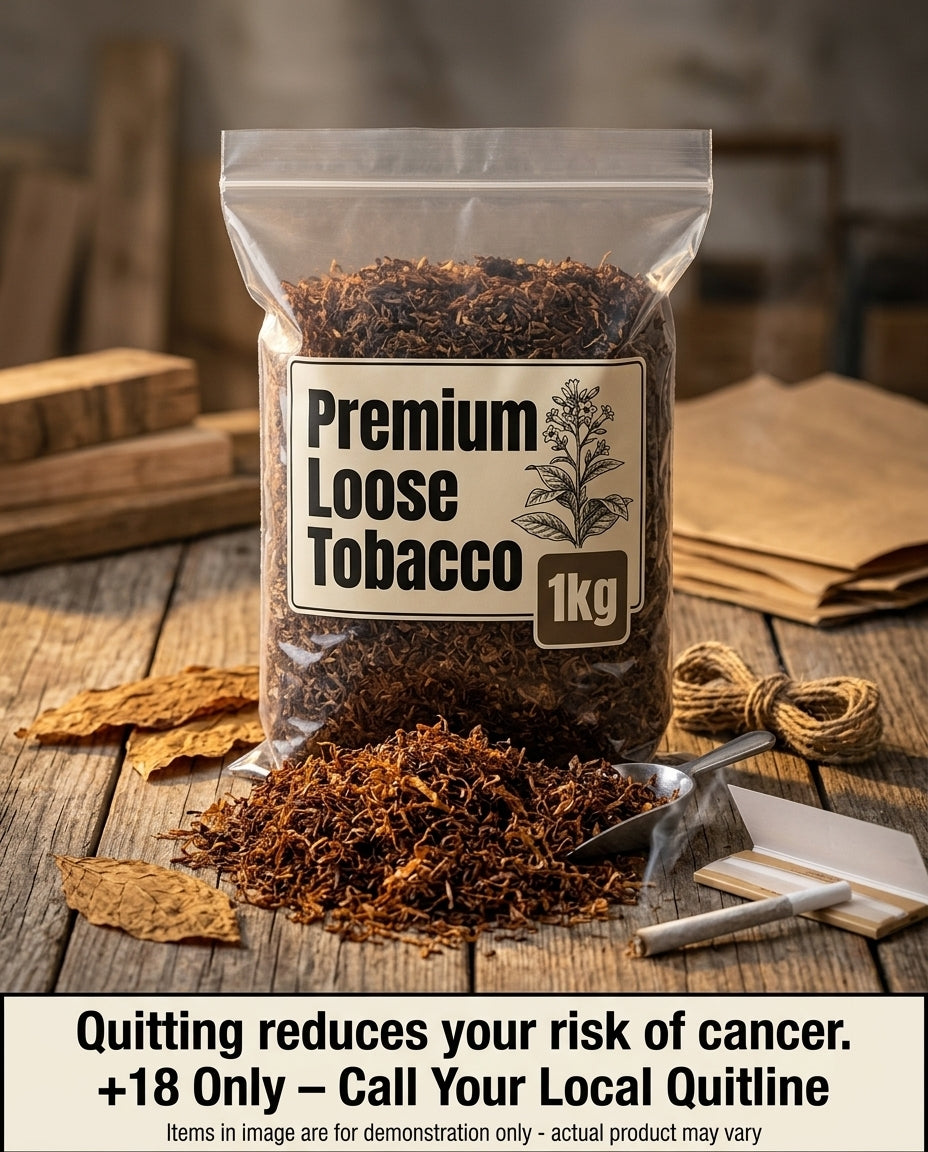
- Premium Loose Tobacco 1kg suits heavy roll-your-own smokers. At around 0.7g a cigarette, a 1kg pouch stretches to roughly 1,400 cigarettes, which is a serious volume discount for anyone smoking daily and wanting nationwide dispatch on a single large order.
- Premium Loose Tobacco 500g fits moderate RYO users who don’t want to commit to a full kilogram upfront. Roughly 700 cigarettes per pouch at the same 0.7g estimate, with fast shipping to your door.
- Manchester Light Cigarettes 20s x 10 Packs is a budget-friendly, smooth mild blend for smokers who prefer factory-made packs over rolling their own. Buying a carton of 10 packs at once typically undercuts buying single packs week to week.
| Product | Best suited to | Format |
|---|---|---|
| Premium Loose Tobacco 1kg | Heavy daily RYO smokers | Bulk pouch |
| Premium Loose Tobacco 500g | Moderate RYO smokers | Mid-size pouch |
| Manchester Light Cigarettes 20s x 10 Packs | Everyday pack smokers wanting budget value | 10-pack carton |
For more on comparing formats and pricing, see our guides on cheap loose tobacco and comparing cigarette prices.
How much do vapes and e-cigarettes change weekly smoking-related costs?
Switching some or all of your smoking to vaping changes your weekly spend, but not always by as much as people expect. A vape device and a steady supply of e-liquid or pods still cost money, and heavy vapers can find themselves spending close to what they did on cigarettes, particularly once they factor in replacement coils, pods and devices that wear out.
Where vaping tends to genuinely lower weekly costs is for smokers who use it to cut down cigarette count rather than replace it entirely. Someone going from 20 cigarettes a day to 10 cigarettes plus a modest vaping habit will usually see their combined weekly spend drop, simply because they’re buying fewer packs. The saving is real, but it’s proportional to how much smoking actually gets displaced, not automatic just because a vape is in the mix.
Vaping products in Australia also sit under their own regulatory settings, separate from tobacco excise, so the price drivers aren’t identical to cigarettes. That means the weekly cost comparison between smoking and vaping shifts over time as rules and product availability change. If you’re weighing up the switch purely on cost, the honest approach is to track your actual weekly vape spend for a few weeks the same way you’d track cigarette spend, rather than assuming it will automatically be cheaper.
Does where you live in Australia change your weekly smoking cost?
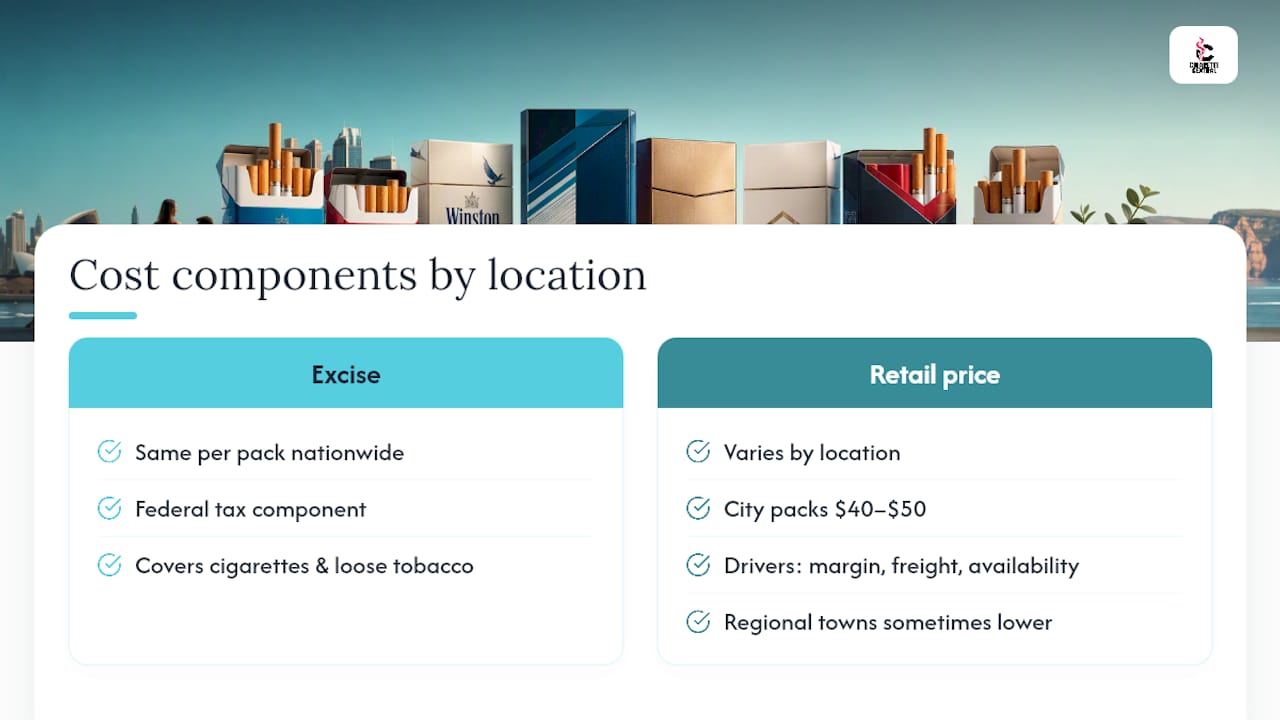
Excise is a federal tax, so the base tax component of every cigarette or gram of loose tobacco is identical whether you’re in Perth or Hobart. What varies by location is retail pricing on top of that tax, and it varies more than most smokers realise.
Capital cities generally sit at the higher end of the $40 to $50 pack-price band, with convenience stores and service stations in high-rent inner-city areas of Sydney, Melbourne and Brisbane often charging toward the top of that range. Regional towns across Queensland, New South Wales and Western Australia sometimes see slightly lower shelf prices, though the gap has narrowed significantly since excise became such a large share of the total cost. Remote and regional areas of the Northern Territory and parts of rural South Australia can actually run higher than city prices, because freight and lower retail competition push margins up.
This is one of the clearer reasons a smoker in a smaller town in Tasmania or country Victoria might find real value in ordering online rather than relying on the local servo. When freight and retailer margin are the main source of regional price variation, buying in bulk from a retailer with nationwide dispatch can flatten that geographic disadvantage instead of paying whatever the nearest shop charges.
What does smoking cost beyond the weekly figure?
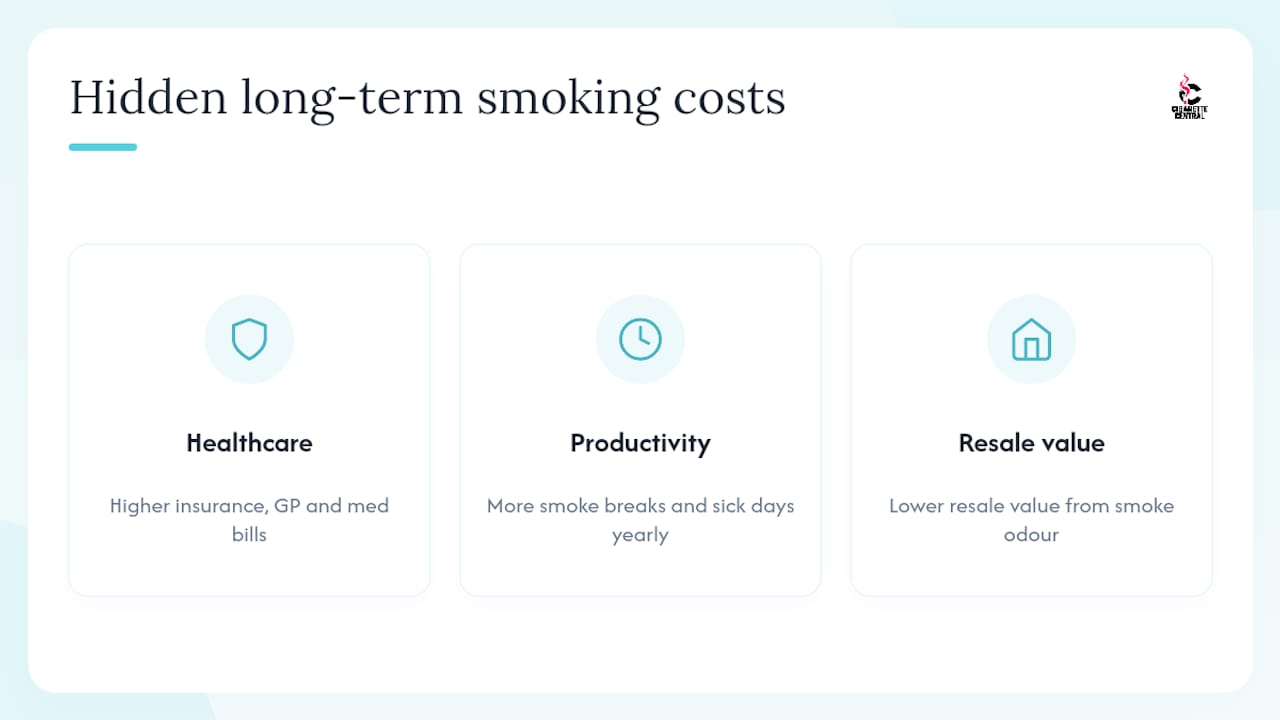
Weekly spend is only the visible part of the ledger. The bigger financial exposure for smokers shows up over years, not weeks, in two forms: healthcare costs and lost productivity.
Smoking-related illness tends to bring higher private health insurance premiums over time, more out-of-pocket costs for GP visits and medication, and a higher chance of expensive hospital treatment later in life. None of that shows up in a weekly pack-price calculation, but it compounds the same way excise does, quietly and consistently.
Lost productivity is less visible again. Smoke breaks add up to real time away from work over a year, and smoking-related illness contributes to more sick days for many smokers than non-smokers take. Add the resale-value hit on a car or home from lingering smoke odour, and the true cost of a smoking habit sits well above the number on a weekly receipt.
None of this is a reason to panic about a single pack purchase. It’s a reason to treat the weekly figure as a floor, not a ceiling, when you’re deciding whether your current habit and spending level actually make sense for you. If quitting is on your radar at all, our breakdown of how much you could save over 12 months puts real numbers against that decision.
What smokers actually say about switching formats
A Cigarette Central customer from regional New South Wales recently told our support team she’d cut her weekly tobacco bill by close to a third after moving from a pack-a-day factory-made habit to a mix of loose tobacco and fewer daily cigarettes. She didn’t quit. She just changed the format and paid closer attention to roll size, and the saving showed up on her weekly budget within a fortnight.
That’s the pattern we see most often: smokers rarely need to overhaul everything to see a real weekly difference. Small, deliberate changes, tracked honestly, tend to beat vague intentions to “smoke less” every time.
Local Cigarette has covered tobacco pricing and consumer buying behaviour in Australia for years, and the numbers in this guide are built on ATO excise data, ABC’s reporting on retail pricing, and the same calculation logic used by Quitline and the Heart Foundation. If you want to check your own numbers, run them through the Quitline calculator or browse Cigarette Central’s product pages to compare formats directly. Fast shipping, discreet packaging and 24/7 support are there if you decide buying online makes more sense than the local servo.
— Local Cigarette
Get your weekly spend under control with Cigarette Central
Cigarette Central is the practical option for Australian smokers who’ve done the maths in this guide and want their weekly number to actually drop.
Whether you’re a heavy RYO smoker eyeing the 1kg loose tobacco pouch, a moderate roller who wants the 500g option without committing to bulk, or someone who prefers ready-made packs and wants the Manchester Light 10-pack carton, secure payment processing and customer support mean you can order with confidence. Browse the current range and place your order today to see exactly how much a switch in format or volume takes off your weekly bill.
Sources
- Excise duty rates for tobacco | Australian Taxation Office
- Legislation
- Australia made cigarettes expensive to stop people smoking. Did it go too far? | ABC News
- Quit smoking cost calculator | Quitline
FAQ
How Much Does the Average Smoker Spend Per Week in Australia?
An average smoker on 13 to 15 cigarettes a day spends roughly $91 to $165 a week, depending on pack price and brand.
How Do I Work Out My Own Weekly Smoking Cost?
Divide your daily cigarette count by 20, multiply by your pack price, then multiply by 7. Calculators from Quitline and the Heart Foundation do this automatically if you’d rather skip the maths.
Is Loose Tobacco Cheaper Than Factory-Made Cigarettes?
Often yes, using a conservative 0.7 grams per cigarette, loose tobacco can cost well under half the price per stick of factory-made packs, though the loose tobacco excise rate is charged per kilogram and savings depend on how tightly you roll.
Why Do Cigarette Prices Keep Rising in Australia?
Excise is indexed twice a year, on March 1 and September 1, tracking wage growth, and excise plus GST make up roughly 70 to 75% of the retail price of a pack.
Can Buying Cigarettes Online Actually Lower My Weekly Spend?
Buying cartons or bulk loose tobacco from a legitimate online retailer with fast shipping can bring the per-pack or per-cigarette cost down compared to single packs bought at a convenience store, and Cigarette Central’s discreet, nationwide dispatch is built around exactly that kind of bulk buying.
Recommended
- How Much Money Can You Save by Quitting Smoking in Australia? A 12-Month Breakdown
- Top Affordable Cigarette Cartons Across Sydney, Melbourne & Brisbane Ranked
- Best Value Cigarette Cartons in Australia for Cheap Smokes & Bulk Savings
- Cigarette Price Comparison: How to Find the Best Deal in Australia
Online Cigarette Central provided article for general information only and is not professional advice. Some Suitable For +18 Only, Call Your Quit Line For Help.


