


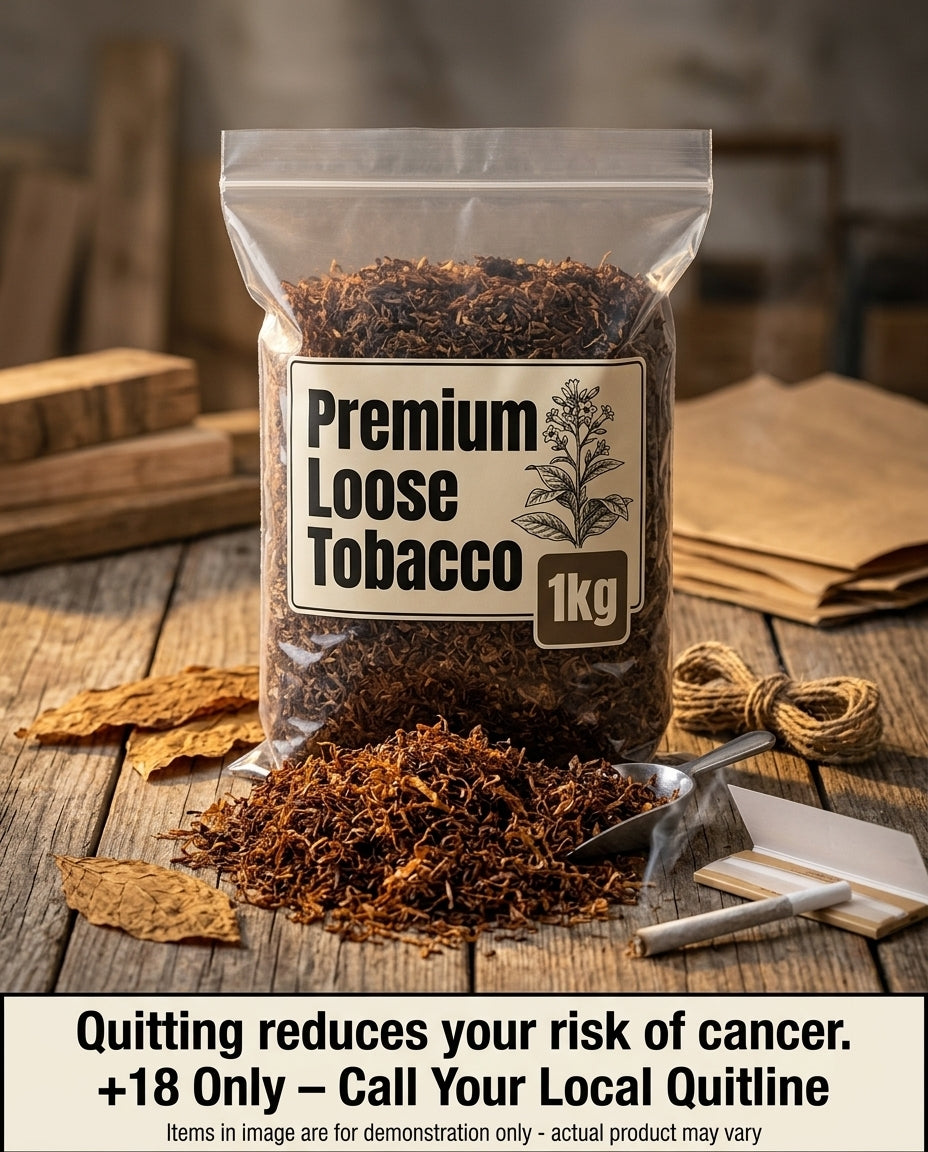










From 1 September 2026, tobacco excise sits at $1.55274 per cigarette stick and $2,587.90 per kilogram of loose tobacco, following an AWOTE indexation factor of 1.016. That pushes a standard 20-pack’s excise component above $31, before GST lands on top of the final shelf price. A political fight over cutting that excise is now running alongside it, and it is covered in detail below.
TL;DR:
- The equivalisation weight for roll-your-own tobacco was locked at 0.6 grams per stick, increasing the effective tax on loose tobacco faster than indexation alone.
- Any proposed significant cut to tobacco excise, such as an 80% reduction, would need to pass legislation and likely face stiff opposition in the Senate; no change is confirmed yet.
- Tobacco prices now range between $45 and $55 for a 20-pack, with loose tobacco prices scaling directly with the excise rate; bulk buying can help offset future rises.
- Australia’s illicit tobacco market remains substantial and growing, prompting increased enforcement and penalties, making legal, taxed products the safest choice.
Table of Contents
- Tobacco excise rates Australia 2026: how the numbers are set
- How does tobacco tax work in Australia when GST is added?
- Are tobacco tax cuts coming to Australia in 2026?
- Illicit tobacco: how big is the black market and what’s changing
- What smokers and retailers need to know for 2026
- How Cigarette Central helps you manage rising prices legally
- Comparing 2026 rates against previous years
- Does tobacco tax enforcement differ by state or territory?
- What revenue does tobacco tax generate for Australia in 2026?
- Are there legal exceptions or lower rates for any tobacco products?
- Does raising tobacco tax actually change smoking behaviour?
- What this means for you right now
- Legal, value options from Cigarette Central
- Sources
- FAQ
Tobacco excise rates Australia 2026: how the numbers are set
The rate you pay isn’t set by a minister on a whim. It moves twice a year, in March and September, tracking Average Weekly Ordinary Time Earnings. The Australian Taxation Office applies this indexation automatically under the Excise Tariff Act, which means the rate rise for September 2026 wasn’t announced as new policy. It was scheduled, mechanical, and entirely predictable to anyone who follows the legislation.
Applied to sticks and to loose tobacco alike, that produces the $1.55274 per stick and $2,587.90 per kilogram figures now in force. The formal record of this sits in Notice No. 4 (2026), the legislative notice that substitutes the new rates under the relevant Excise Tariff Act subitems.
There’s a second, quieter change buried in this update that matters more for roll-your-own smokers than the headline indexation figure. It’s called the equivalisation weight, and it’s the number regulators use to convert a “stick” of RYO tobacco into an excise‑equivalent unit for per‑kilogram taxation.
- Since 2017, the equivalisation weight has stepped down gradually, from 0.8g toward 0.6g per notional stick.
- The 1 September 2026 update completes that schedule, locking the weight at 0.6g.
- A lower equivalisation weight means each kilogram of loose tobacco is treated as containing more “sticks” for tax purposes, so the effective duty burden per kilogram rises faster than the AWOTE indexation alone would suggest.
- This is the specific mechanism that has closed most of the price gap that once made rolling your own noticeably cheaper than packet cigarettes per cigarette.
For manufacturers and importers, there’s also a classification trap worth knowing about even if you’re just a smoker trying to understand your dollar. A cigarette weighing more than 0.8 grams gets reclassified out of the per‑stick rate and into the per‑kilogram rate, which can mean a sharply higher duty bill on products near that threshold. It’s a detail that shapes what pack formats and stick weights you’ll see on shelves, not just how much they cost.
How does tobacco tax work in Australia when GST is added?
Two separate taxes stack on every purchase. Excise is charged first, calculated per stick or per kilogram depending on the product. GST then applies at 10% to the final retail price, which already includes the excise component, freight, and retailer margin.
For a standard 20-pack:
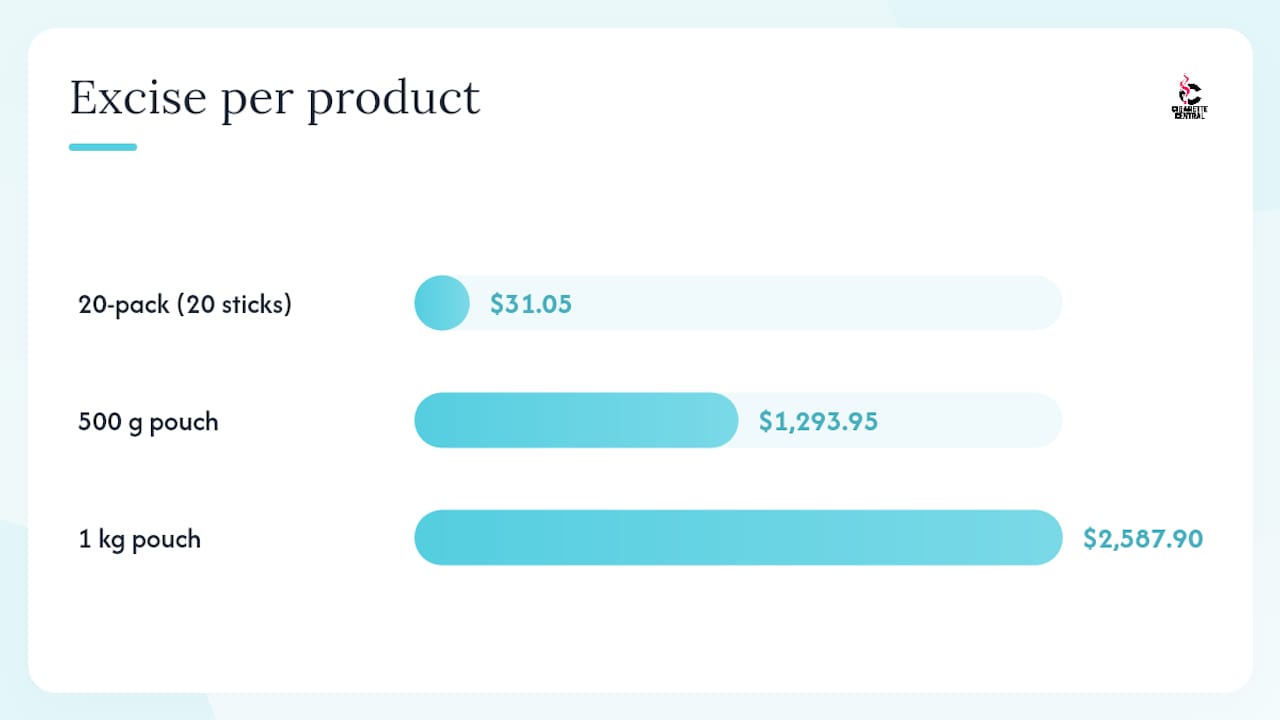
- Excise cost: 20 sticks × $1.55274 = $31.05 in excise alone.
- Add manufacturing, distribution, and retail margin, which historically add several dollars per pack.
- Apply 10% GST to the pack’s full pre-tax retail price, not just the excise component.
Excise accounts for a majority share of the shelf price of a typical packet of cigarettes once GST is layered on top, according to analysis compiled by Tobacco in Australia.
For loose tobacco, the maths scales differently but tells the same story:
- A 500g pouch carries excise of 0.5 × $2,587.90 = $1,293.95 before any margin or GST.
- A 1kg pouch carries excise of $2,587.90 outright, again before margin and GST.
- GST then applies to the marked‑up retail total, not the raw excise figure.
Because GST is calculated on the tax-inclusive retail price, every excise rise automatically inflates the GST take too. A 1.6% excise increase doesn’t just cost you 1.6% more. It costs you 1.6% more on the excise, plus 10% of that extra amount again in GST, a small but real compounding effect that repeats every March and September.
Are tobacco tax cuts coming to Australia in 2026?
Maybe, but not yet, and the politics are loud. In early September 2026, the Coalition put forward a proposal to slash tobacco excise by as much as 80%, paired with a plan to legalise and regulate vapes more tightly, arguing it would starve the illicit tobacco trade of its price advantage. One Nation has floated similar excise‑cutting rhetoric, framing high legal prices as the reason organised crime controls so much of the tobacco supply.
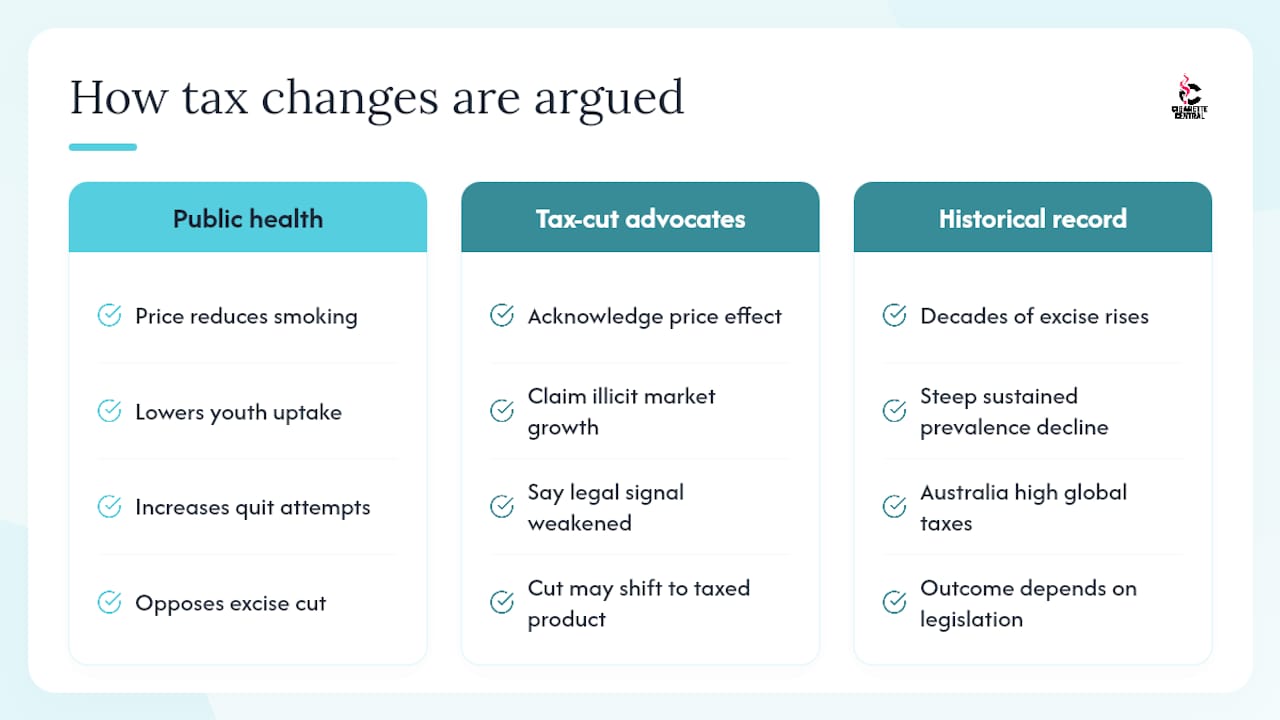
Public health groups didn’t wait long to respond. The Australian Medical Association and Cancer Council both raised serious objections, and Labor described the Coalition’s plan in stark terms, warning it risks reversing decades of smoking decline. Their argument rests on a body of evidence showing price is one of the strongest levers governments have over smoking rates. Cut the price sharply, and more people, particularly younger and lower‑income smokers, are likely to smoke more or take it up in the first place.
What should you actually watch for?
- Budget announcements. Any excise change of this scale would typically be flagged in a federal budget or mid‑year economic statement before legislation is drafted.
- Election commitments. Excise policy tends to become a bargaining chip in the run‑up to elections rather than a mid‑term reform.
- Bill introduction and passage. A proposal is not law. It needs to clear both houses, and a swing of this size would almost certainly face a difficult Senate.
- Transitional arrangements. Even if a cut passed, expect a phase‑in period rather than an overnight price drop.
Nothing here has passed as law. Treat every “cigarettes could get cheaper” headline as a proposal until it clears Parliament, not a certainty.
Illicit tobacco: how big is the black market and what’s changing
Estimates of Australia’s illicit tobacco market vary depending on who’s counting, but every credible estimate agrees it’s substantial and growing as legal prices climb. Illegal “chop chop” tobacco and unbranded imported cigarettes routinely sell for a fraction of the taxed retail price, which is precisely the gap driving both the Coalition’s tax‑cut argument and the government’s enforcement response.
The government’s answer isn’t a tax cut. It’s the Combatting Illicit Tobacco Bill 2026, which expands enforcement powers and increases penalties for importing, manufacturing, or selling untaxed tobacco, according to analysis from the Parliamentary Library.
What this means in practice:
- Expect more visible enforcement activity, including retail raids and stronger border detection targeting illicit tobacco shipments.
- Penalties for supplying illicit product are increasing, and that risk falls on buyers too, not just sellers, since possession of unexcised tobacco carries its own legal exposure.
- Cheaper illicit tobacco doesn’t come with any quality control, batch testing, or product accountability. You genuinely don’t know what you’re buying.
- Sticking to lawful, taxed products remains the only way to avoid both legal risk and the total unpredictability of an unregulated supply chain.
What smokers and retailers need to know for 2026
Retail prices for a standard 20‑pack of major brands now commonly sit somewhere between $45 and $55, depending on brand and retailer margin, with loose tobacco pricing scaling in step with the $2,587.90 per kilogram excise rate. Exact shelf prices vary by retailer, so treat these as a planning range rather than a fixed figure.
A few practical, legal points worth knowing:
- Duty‑free limits are strict. Travellers entering Australia can bring in a limited quantity of tobacco duty‑free; anything beyond that threshold attracts excise‑equivalent duty on arrival, and our guide to Australian tobacco purchase limits breaks down the current thresholds.
- Compare cost per cigarette, not just pack price. Loose tobacco can still work out cheaper per cigarette than packet smokes, but the gap has narrowed since the equivalisation weight changes took effect.
- Track the twice‑yearly indexation. Prices move every March and September, so budgeting around those dates avoids surprises.
- Follow policy announcements, not just headlines. A proposed excise cut isn’t a price cut until it’s legislated.
Pro Tip: Buying larger pack sizes or bulk loose tobacco when you’re already due for a restock tends to smooth out the per‑unit cost impact of each indexation rise, rather than topping up small amounts every few weeks at whatever the current shelf price happens to be.
How Cigarette Central helps you manage rising prices legally
Rising excise doesn’t leave smokers with many levers to pull, but where you buy and how you buy still matter.
Two broad purchase categories suit different smokers:
- Pre‑packed retail 20‑packs suit anyone who wants brand consistency and doesn’t want to roll their own.
- Loose tobacco by weight suits smokers chasing a lower cost per cigarette, and our guide to value loose tobacco in Australia explains how the per‑gram maths stacks up post‑indexation.
If you’re weighing up brand options against value alternatives, our rundown of value tobacco brands for 2026 is a useful next stop, and our explainer on why buying tobacco online tends to cost less covers the retail economics behind those savings.
Every order still requires age verification at checkout, and Cigarette Central operates strictly within Australian duty and excise law. There’s no way around the tax, and we’re not pretending otherwise, but there’s a real difference between paying full uncompetitive retail margin and buying from a retailer built around volume and efficient shipping.
Comparing 2026 rates against previous years
The trajectory here is consistent and, frankly, unsurprising once you understand the indexation mechanism. Every March and September since the AWOTE‑linked indexation regime began, the per‑stick and per‑kilogram rates have climbed, with occasional larger jumps layered on top during periods when governments added one‑off increases beyond wage indexation.
That’s a structural change, not a routine adjustment, and it means loose tobacco duty has risen faster than the headline indexation number suggests for several years running. Anyone comparing 2026 prices to what they paid five years ago will notice packet cigarettes and rolling tobacco have converged much closer in cost per cigarette than they used to be, a gap that’s shrunk specifically because of this equivalisation mechanism rather than indexation alone.
Looking back further, the broader pattern is decades of steady real‑price increases, occasionally punctuated by larger discretionary hikes on top of standard indexation, reflecting a long‑running bipartisan policy consensus that price increases suppress smoking rates. The 2026 political proposal to cut excise sharply would be the first major reversal of that multi‑decade trend if it were ever legislated.
Does tobacco tax enforcement differ by state or territory?
Excise itself is a federal tax, set uniformly under Commonwealth law, so the actual rate you pay is identical whether you’re buying in Sydney, Perth, Darwin, or a small town in regional Tasmania. There’s no state‑level variation in the excise rate itself.
Where states and territories do diverge is enforcement and retail regulation. Tobacco retailing licences, display and advertising restrictions, and penalties for selling to minors are set at state and territory level, which means compliance activity, inspection frequency, and licensing fees vary from Queensland to Victoria to South Australia. Some jurisdictions have pushed harder than others on illicit tobacco retail crackdowns, particularly in response to the visible rise of illegal tobacconists in suburban strip shopping centres in cities like Melbourne and Brisbane.
This creates a patchwork effect on the ground. A retailer in regional New South Wales might face different licensing scrutiny than one in inner‑city Adelaide, even though both are selling product taxed at the exact same Commonwealth rate. If you’re a retailer rather than just a smoker, checking your specific state or territory’s retail licensing requirements alongside the federal excise rate matters, because non‑compliance penalties sit outside the ATO’s jurisdiction entirely.
What revenue does tobacco tax generate for Australia in 2026?
Tobacco excise remains one of the more reliable line items in the federal budget, generating billions of dollars annually even as smoking prevalence has trended downward for years. The dynamic at play is straightforward: fewer people smoke, but each of them pays a substantially higher rate per cigarette, and for a long stretch that’s kept total revenue relatively stable despite falling consumption volumes.
That balance is exactly what’s now in political dispute. Whether that trade‑off would actually work is precisely the point public health groups and the government are contesting.
For now, revenue projections for the 2026 to 2027 financial year assume the current rate structure holds, which means budget planning still relies on the $1.55274 per stick and $2,587.90 per kilogram rates continuing on their scheduled indexation path rather than any proposed cut.
Are there legal exceptions or lower rates for any tobacco products?
Very few, and none that meaningfully help the average adult smoker looking for a cheaper legal pack. Duty‑free allowances for travellers arriving in Australia remain the main concession, letting you bring in a strictly limited quantity without paying import duty, detailed in our guide to Australian duty‑free tobacco limits.
Beyond that, there’s no concessional excise rate based on income, age (beyond the minimum legal purchase age of 18), or health status. Tobacco excise applies uniformly to every commercially sold cigarette and every gram of loose tobacco content, regardless of who’s buying it. Products marketed as “additive‑free” or “organic” tobacco carry precisely the same excise burden as any other brand, since the tax is levied on tobacco content and stick classification, not on formulation or marketing claims.
The one genuine classification nuance worth knowing is the 0.8‑gram stick weight threshold mentioned earlier. It’s not a concession for consumers, but it does explain why some heavier cigarette formats are priced differently than standard sticks, since crossing that weight line shifts a product into per‑kilogram taxation entirely.
Does raising tobacco tax actually change smoking behaviour?
Public health evidence consistently points to price as one of the most effective levers for reducing smoking, and that’s exactly why the 2026 tax‑cut debate has generated so much noise. Higher prices are linked to lower youth uptake, more quit attempts among existing smokers, and reduced overall consumption, which is the core argument the AMA and Cancer Council are making against the proposed excise cut.
The counterargument from tax‑cut advocates isn’t that price doesn’t influence behaviour. It’s that current prices have pushed so many smokers toward the illicit market that the legal price signal has stopped working as intended, and cutting excise might redirect consumption back to taxed, regulated product rather than genuinely increasing overall smoking rates. Whether that theory holds is essentially untested at this rate of proposed cut, which is exactly why public health groups are treating it as a dangerous experiment rather than a proven fix.
What’s not in serious dispute is the historical pattern: Australia’s decades of steady excise increases have coincided with one of the steepest sustained declines in smoking prevalence among comparable countries, and Australia is frequently cited as having among the highest tobacco taxes in the world. Whether the 2026 proposals disrupt that trend depends entirely on what, if anything, actually gets legislated.
What this means for you right now
The number that matters today is $1.55274 per stick and $2,587.90 per kilogram, effective from 1 September 2026, and every proposal to change that is still just a proposal. If you smoke, your practical planning should assume current rates hold until legislation says otherwise, not until a press conference does.
Watch three things over the coming months: any federal budget statement referencing excise, movement on the Combatting Illicit Tobacco Bill, and whether the Coalition’s excise‑cut plan actually gets drafted into a bill rather than remaining a policy announcement. Election‑cycle promises on tax rarely survive contact with the Senate unchanged.
If there’s one action worth taking now, it’s checking the ATO’s excise rate page directly rather than relying on secondhand summaries, and cross‑checking retailer product pages before assuming a price you saw last month still applies.
– Local Cigarette
Legal, value options from Cigarette Central
If you’re an adult smoker trying to absorb the September rate rise without paying full uncompetitive retail margin on top of it, buying in bulk from a value‑focused retailer is one of the few legal levers left. Cigarette Central’s Premium Loose Tobacco 500g offers a rich, smooth‑rolling blend sized for smokers who want to test value tobacco without committing to a full kilogram, with fast shipping straight to your door. For heavier smokers or households buying together, the Premium Loose Tobacco 1kg delivers deeper flavour control and stronger per‑gram value, dispatched nationwide.
Every order requires age verification at checkout, in line with Australian law, and all excise and duty‑free limits still apply exactly as described earlier in this guide. Cigarette Central isn’t offering a way around the tax system, it’s offering fast, discreet, competitively priced access to the same taxed, legal product you’d find anywhere else, minus the retail markup of a bricks‑and‑mortar tobacconist. Check current stock and pricing on either product page before your next restock, since prices adjust in step with each indexation cycle.
Sources
- Excise duty rates for tobacco | Australian Taxation Office
- NOTICE No. 4 (2026) — legislative notice of substituted excise rates
- Coalition unveils plan to slash tobacco tax, legalise and regulate vapes — ABC News
- 13.6 What tobacco taxes apply in Australia? — Tobacco in Australia
FAQ
What is the current cigarette tax rate in Australia?
As of 1 September 2026, excise is $1.55274 per stick for cigarettes up to 0.8 grams, or $2,587.90 per kilogram for loose tobacco and heavier sticks, set under AWOTE indexation.
What is the price of a pack of 20 cigarettes in Australia?
Most major brands sit between $45 and $55 per 20‑pack in 2026, though exact pricing varies by retailer and brand.
Is buying cheap cigarettes online in Australia legal?
Yes, buying taxed, legal tobacco products online from an Australian retailer is legal for verified adults aged 18 and over, provided the retailer applies age verification and the products carry the correct excise.
Will the proposed tobacco tax cut actually happen in 2026?
Not yet.
Recommended
- Examples of value tobacco brands in Australia: 2026 guide
- Cigarette price comparison: how to find the best deal in Australia
- Best cigarette brands in Australia 2026: affordable and popular picks
- Top Affordable Cigarette Cartons Across Sydney, Melbourne & Brisbane R
Online Cigarette Central provided article for general information only and is not professional advice. Some Suitable For +18 Only, Call Your Quit Line For Help.


