





Yes — most dry tobacco is salvageable. The fastest, safest options are:
- Sealed jar with a humidifier disc or damp sponge (barrier method, no direct contact): results in 24–48 hours for lightly dried tobacco.
- Damp paper towel or shot-glass trick in a sealed container: a quick household fix that works overnight to 24 hours.
- Boveda or clay humidifier packets: the slowest but most controlled approach, typically 2–4 days, with very low mould risk.
One honest caveat up front: re-moisturising tobacco restores water content and smokability, but volatile aromatic oils that have already evaporated are largely gone for good. You will get a smokeable product back, rarely an identical one.
Key takeaways
Rehydrating dry tobacco works for structurally intact leaf, but volatile oils lost during drying do not return — prevention through airtight storage is always the better option.
| Point | Details |
|---|---|
| Most dry tobacco is salvageable | Intact strands respond to rehydration; powdered or mouldy tobacco should be discarded. |
| Use distilled water only | Tap water introduces chlorine and minerals that taint flavour and encourage microbial growth. |
| Boveda packs are the safest method | They take 2–4 days but carry the lowest mould risk, making them ideal for larger batches. |
| Store in small airtight glass jars | Splitting stock into 250 ml Mason jars reduces air exchanges and preserves aroma long-term. |
| Cigarettecentral ships fresh tobacco Australia-wide | When a batch is beyond saving, fresh loose tobacco and cigarettes are available with 2–5 day delivery. |
Table of Contents
- Why does dried tobacco taste and burn differently?
- Is your tobacco worth saving, or should you discard it?
- How to re-moisturise dry tobacco: step-by-step methods
- How do you know when the tobacco is ready?
- How to store loose tobacco and keep cigarettes fresh long-term
- Common mistakes that ruin a rehydration attempt
- What to realistically expect after rehydration
- Australian smokers: local tips and a real-world rescue story
- Fresh tobacco and rehydration supplies from Cigarettecentral
- Sources
- FAQ
Why does dried tobacco taste and burn differently?
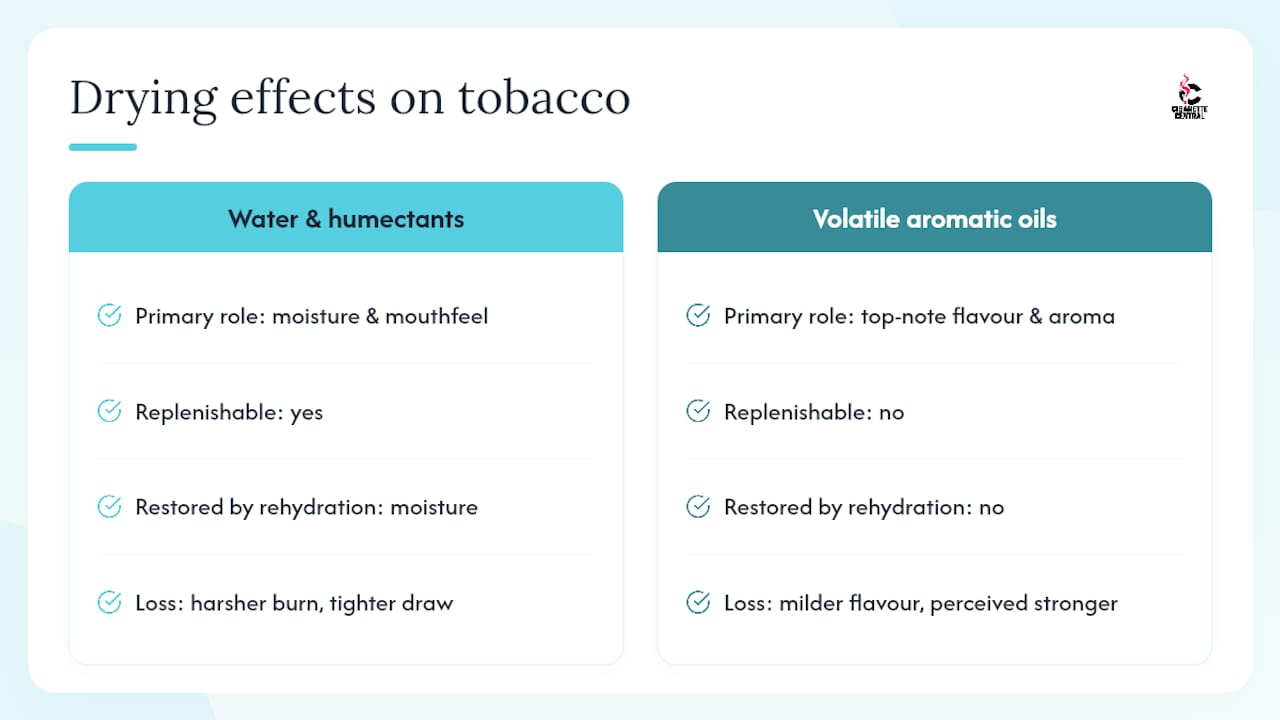
Tobacco contains two distinct types of compounds that drying affects very differently. Water content and humectants — the hygroscopic sugars and glycerol naturally present in cured leaf — can be replenished with the right technique. Volatile aromatic oils, the compounds responsible for top-note flavour and aroma, cannot. Once they evaporate, they do not return.
The practical result is a harsher burn, a tighter draw, and a perceived increase in strength. Stable storage preserves aroma far better than repeated reconditioning, which is why prevention is always the smarter play. Still, understanding what drying actually removes helps you set realistic expectations before you commit time to a rescue.
Pro Tip: Aromatic blends lose more perceptible flavour during drying than natural or Virginia blends. If your tin is an aromatic, expect a noticeably milder result after rehydration.
Is your tobacco worth saving, or should you discard it?
Not every dry tin deserves the effort. Run through this checklist before you start.
- Check the structure. Squeeze a pinch gently. If the strands spring back even slightly and hold their shape, the leaf still has cellular integrity. If it crumbles instantly to fine dust, the oils and physical structure are gone — once leaf becomes powder it has lost oils and cellular integrity, and rehydration will not help.
- Smell it. Dry tobacco smells flat or papery. That is fine. A sour, ammonia-like, or musty odour is a red flag.
- Look for mould. Check under good light for white, grey, or blue-green patches, fuzzy growth, or unusual spotting.
- Assess the colour. Uniform tan or brown is normal. Uneven dark patches combined with a bad smell suggest microbial activity.
- Decide. Intact strands with a flat smell: attempt rehydration. Powder or mould: discard.
How to re-moisturise dry tobacco: step-by-step methods
PipesMagazine recommends humidifier discs, damp sponge methods, and careful timing — and the no-direct-contact rule applies to every method below.
Method A: sealed jar with a humidifier disc or clay cookie
Place your tobacco loosely in a clean glass jar. Set a clay humidifier disc (lightly dampened with distilled water and wiped dry on the outside) on a small piece of foil or a bottle cap so it sits above the tobacco without touching it. Seal the jar. Check every 12 hours. Remove the disc once the tobacco feels pliable and no longer brittle. Typical time: about one to two days.
Method B: damp paper towel or shot-glass trick
Lay a sheet of paper towel dampened with distilled water on the inside lid of a sealed container, or place a shot glass containing a small amount of distilled water inside the container alongside the tobacco. The tobacco must not touch the wet surface. Seal and leave overnight. Typical time: about half a day to one day. Check frequently — this method moves faster and over-wetting is the main risk.
Method C: Boveda or humidity-control packets
These two-way packs add or absorb humidity as needed. Typical time: a few days. This is the most forgiving method and the lowest mould risk, making it the best choice for larger batches.
Method D: light distilled-water spritz
For ribbon-cut or pipe tobacco only — not fine-cut or cigarette tobacco. Fill a clean spray bottle with distilled water and mist lightly from 20–30 cm away. Spread the tobacco on a clean surface, turn it gently, then jar it loosely and seal. Typical time: several hours to overnight. The risk here is uneven hotspots, so turn the tobacco once mid-way through.
Method E: rum or whisky infusion (last resort)
Dampen a small piece of cloth or paper towel with a few drops of rum or whisky — not soaked, just lightly touched. Place it in the jar using the barrier method above. This adds a faint flavour note and can partially mask the flatness of heavily dried aromatics. Use sparingly; too much alcohol will make the tobacco harsh and difficult to light.
| Method | Time to use | Mould risk | Flavour change | Best for |
|---|---|---|---|---|
| Clay disc / humidifier | 24–48 hrs | Low | Minimal | Pipe blends, loose tobacco |
| Paper towel / shot glass | 12–24 hrs | Medium | Minimal | Small batches, quick fix |
| Boveda / humidity pack | 2–4 days | Very low | Minimal | Large batches, aromatics |
| Distilled-water spritz | A few hrs–overnight | Medium | Low | Ribbon / pipe cut only |
| Rum / whisky infusion | 12–24 hrs | Medium | Noticeable | Heavily dried aromatics |
How do you know when the tobacco is ready?
Checking progress takes less than a minute and saves you from over-wetting an entire batch.
- Squeeze test: pinch a small amount. It should compress slightly and spring back without crumbling. If it still snaps apart, give it more time.
- Roll test: try rolling a small pinch between your fingers. Properly hydrated loose tobacco rolls without tearing or sticking together in a wet clump.
- Smell test: the flat, papery smell should be replaced by the tobacco’s natural scent. If it smells damp or earthy, it has gone too far.
- Small burn test: pack a tiny amount and light it. It should draw smoothly and stay lit without constant relighting.
Pro Tip: Test a teaspoon of tobacco first rather than the whole batch. If the small test goes wrong, you have only lost a pinch.
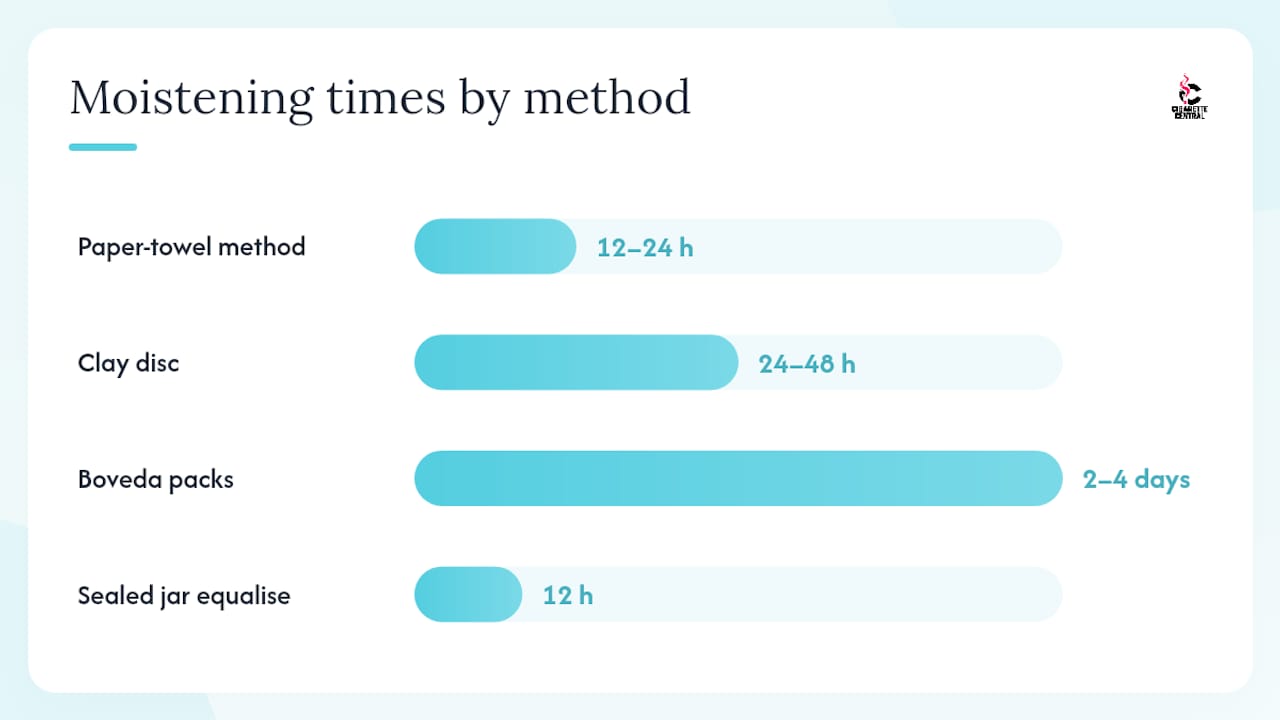
Timing rules of thumb: the paper-towel method works in 12–24 hours; the clay disc in 24–48 hours; Boveda packs in 2–4 days. Once the tobacco feels right, remove the humidifying source and let the jar sit sealed for another 12 hours to equalise before you commit to the whole batch.
How to store loose tobacco and keep cigarettes fresh long-term
Prevention is far cheaper than rescue. Splitting stock into smaller jars reduces air exchanges and preserves aroma better than periodic rehydration, and the principle applies equally to loose tobacco and open cartons.
- Use airtight glass jars. Mason jars and Kilner jars are widely available at supermarkets and kitchenware stores across Australia. They seal reliably and do not impart flavour.
- Keep containers small. A 250 ml jar for daily use, larger jars for long-term stock. Every time you open a jar, you exchange air and lose humidity.
- Store in a cool, dark place. A cupboard away from the stove or any heat source works well. Avoid the car, the bathroom, and anywhere with temperature swings.
- Add a passive humidity source. A Boveda pack or a lightly dampened clay disc maintains stable conditions without monitoring.
Common mistakes that ruin a rehydration attempt
A few small errors account for most failed rescues.
- Using tap water. Chlorine and minerals in tap water can permanently taint flavour and encourage microbial growth. Always use distilled water.
- Letting the moisture source touch the tobacco. Direct contact creates wet patches that go mouldy within hours. Always use a barrier — foil, a bottle cap, or a separate small container.
- Rushing with heat or steam. Rapid rehydration with heat can drive off volatile compounds or create hotspots and mould risk. A clothes iron, a kettle, or a microwave are not tools for this job.
- Using apple or potato slices. A popular folk remedy, but fruit and vegetable matter introduce sugars and bacteria that accelerate mould growth. The tobacco may smell faintly of apple for a day, then go off.
- Over-wetting. Tobacco that feels wet to the touch needs to be spread on a clean surface and allowed to dry partially before re-jarring.
What to realistically expect after rehydration
Community experience on TobaccoReviews forums is consistent: rehydrated tobacco becomes smokeable again, but some volatile oils are permanently lost. The degree of loss depends on how long the tobacco was dry and how it was stored.
Natural and Virginia blends tend to recover better than aromatics, because their flavour profile relies more on the leaf itself than on added top dressings. Aromatics, by contrast, depend heavily on applied flavourings that evaporate quickly. If your tin is a heavily cased aromatic and it has been dry for months, the honest recommendation is to replace it rather than rescue it.
For understanding how blend composition affects what you taste after rehydration, the origin and processing of the leaf matter as much as the moisture level.
Australian smokers: local tips and a real-world rescue story
A customer from Brisbane shared a common experience: a 50 g pouch of Golden Virginia left in the glovebox over a Queensland summer came out bone dry. The fix was straightforward — a clean 500 ml Mason jar, a clay disc dampened with distilled water from the supermarket, and 36 hours of patience. The tobacco smoked again, though the flavour was noticeably flatter than fresh. The lesson: the car is the worst possible storage spot in any Australian state.
Local procurement tips for Australian smokers:
- Boveda packs are available at tobacconists in Sydney, Melbourne, Brisbane, and Adelaide, and through online retailers.
- Clay humidifier discs are sold at kitchenware and specialty stores; a food-grade terracotta disc works identically.
- Mason and Kilner jars are stocked at Coles, Woolworths, and Kmart nationwide.
- Distilled water is available at supermarkets and automotive stores (sold for battery top-up) across every state and territory.
Climate note: Northern Queensland, Darwin, and coastal Western Australia experience high ambient humidity in summer, which can actually over-hydrate stored tobacco without a two-way humidity pack. In these climates, a Boveda pack that both adds and absorbs moisture is more reliable than a one-way clay disc.
Fresh tobacco and rehydration supplies from Cigarettecentral
Sometimes the honest answer is that a batch is too far gone to rescue, and a fresh supply is the better call.
- Premium Loose Tobacco 500g — a rich, smooth rolling blend shipped fresh; the practical replacement when a pouch is beyond saving.
- Davidoff Red Cigarettes 20s x 10 Packs — a full-flavour European blend for smokers who prefer ready-to-use over rolling.
- Full tobacco range — browse loose tobacco, cigarettes, and accessories in one place.
Browse the full catalogue at Cigarettecentral and check current deals before your next order.
Sources
- Pipesmagazine
- Rehydrating Tobacco | Tobacco Talk | Tobacco Reviews Forum
- Humidity and tobacco storage – how to preserve freshness and aroma | HUZARK
FAQ
Can you re-moisten dried-out tobacco?
Yes. Most dried tobacco with intact leaf structure can be rehydrated using a sealed jar with a humidifier disc, a damp paper towel, or a Boveda humidity pack. Expect smokability to return within 12–48 hours, though some aroma loss is permanent.
How do you rejuvenate stale tobacco quickly?
The fastest household method is the shot-glass trick: place a small amount of distilled water in a shot glass inside a sealed container with the tobacco, without letting them touch. Check after 12 hours.
How do you rehydrate a bag of loose tobacco?
Transfer the tobacco to a clean glass jar, add a lightly dampened clay disc or a Boveda pack using a barrier so it does not contact the leaf, then seal the jar. Check every 12 hours using the squeeze test until the tobacco feels pliable and springs back slightly.
How do you make dry snuff wetter?
Apply a very small amount of distilled water with a clean fingertip or a fine mist, mix gently, and seal in an airtight container for several hours. Add water in tiny increments — snuff over-wets quickly and is difficult to dry back out without flavour loss.
When is tobacco too far gone to save?
If the leaf has crumbled to fine powder, lost all structural integrity, or shows any sign of mould, it is beyond practical recovery. Discard it and replace with a fresh supply rather than risk a poor smoke or a health concern.


