





TL;DR:
- Plain packaging for tobacco strips branding from packs to reduce appeal and eliminate advertising.
- Online shops must comply with laws requiring all tobacco products to be shipped in plain, unbranded packaging.
Plain packaging for tobacco is defined as standardised packaging that strips all logos, colours, and promotional brand imagery from tobacco packs, leaving only regulated brand names and mandatory health warnings. Online tobacco shops use plain boxes because the law requires it. Across Australia and 25 other jurisdictions globally, plain packaging laws mandate that every tobacco product sold must meet strict packaging standards. This is not a retailer preference or a discreet shipping choice. It is a legal obligation with public health objectives at its core.
Why online tobacco shops use plain boxes: the regulatory reason
Plain packaging, also called standardised packaging, is defined by the WHO’s FCTC guidance as packaging that removes all distinctive branding elements from tobacco products. The pack must carry only a standardised brand name in a regulated font and size, alongside prominent health warnings. No colours, no logos, no promotional graphics.
The WHO Framework Convention on Tobacco Control identifies four core public health objectives behind plain packaging:
- Reduce product appeal. Colourful, well-designed packaging makes tobacco products look attractive. Plain packaging removes that visual appeal entirely.
- Eliminate pack-based advertising. The pack itself has historically functioned as a marketing tool. Plain packaging ends that function.
- Prevent misleading claims. Colour coding and design elements have been used to imply that some products are safer than others. Plain packaging removes those cues.
- Increase health warning visibility. Without competing brand graphics, graphic health warnings become the dominant visual element on the pack.
These four objectives explain why the policy exists. They also explain why online retailers have no choice but to comply. The law applies to the product itself, not just how it is displayed in a shop.
As of november 2025, 26 jurisdictions worldwide have adopted plain packaging, with three more pending implementation. That number has grown steadily since Australia became the first country to introduce the policy in 2012. The international spread of this regulation means online tobacco retailers operating across borders face a consistent and growing compliance requirement.
Canada’s approach illustrates how detailed these rules can get. Canadian regulations specify not just the absence of branding but the physical construction of the pack itself, including shape (rectangular cuboid), material (rigid cardboard), and structural requirements. This goes well beyond aesthetics. It means manufacturers and retailers cannot substitute alternative packaging formats to work around the rules.
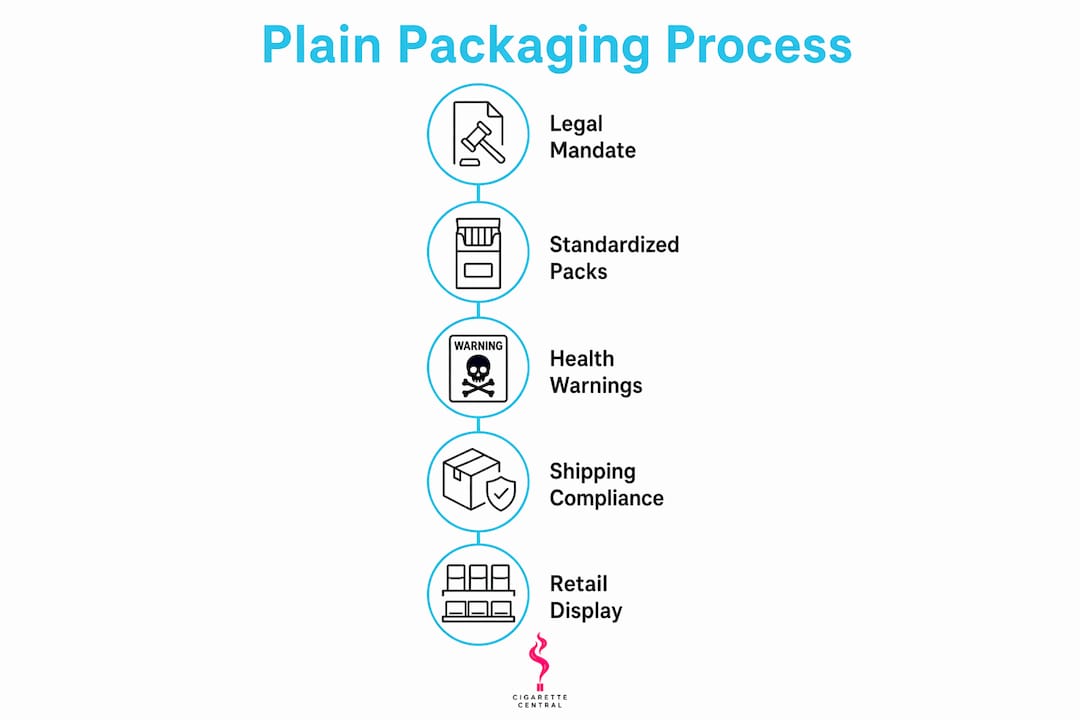
Pro Tip: If you receive a tobacco order and the pack looks identical to others regardless of brand, that uniformity is intentional. It is the direct result of standardised packaging law, not a packaging error.
Health warnings are also tightly regulated in their own right. Canadian health warning rules govern the size, placement, and rotation of warnings on every pack. This ensures warnings cannot be minimised or obscured by design choices.
How do plain packaging laws affect online tobacco shops and shipping?
Online tobacco retailers face a two-layer compliance challenge. The retail pack (the cigarette box itself) must comply with plain packaging laws. The outer shipping package must comply with separate transport and carrier regulations. Both layers are regulated, and both contribute to why your order arrives in plain, unbranded packaging.
The distinction between these two layers matters. WHO guidance confirms that plain packaging requirements apply to the retail pack. Outer shipping boxes are subject to different rules, including carrier policies and transport regulations that often prohibit visible tobacco branding on parcels.
For online tobacco shops, the operational impacts of these laws are significant:
- Product sourcing compliance. Every product stocked must already be in a compliant plain pack before it reaches the retailer. Online shops cannot repackage products themselves to meet regulations.
- Age verification at delivery. Laws governing online tobacco sales in many jurisdictions require age verification at the point of delivery, not just at checkout. This affects how carriers handle tobacco parcels and what documentation is required.
- Carrier restrictions. In the United States, the PACT Act requires online tobacco sellers to register with tax authorities, report sales, verify customer age, and comply with strict shipping rules. Major carriers have responded by limiting or refusing tobacco deliveries altogether. This forces online retailers to use specialist carriers and plain outer packaging to meet both legal and carrier requirements.
- Tax and reporting obligations. Online tobacco sellers must collect and remit applicable taxes, adding an administrative layer that physical retailers do not always face in the same way.
- Record-keeping requirements. Compliance with shipping laws requires detailed records of each transaction, including age verification outcomes and delivery confirmation.
The result is that an online tobacco order arrives in a plain outer box not because the retailer is trying to be discreet for your benefit. It arrives that way because the law requires it at every stage of the supply chain.
Pro Tip: When ordering tobacco online, check that the retailer clearly states compliance with local packaging and age verification laws. A reputable shop will confirm this in its shipping and legal information pages.

Understanding online tobacco pricing also helps here. Online retailers often pass on savings from lower overhead costs, but those savings do not come at the expense of regulatory compliance.
Why is branding restricted, and how do online shops adapt their marketing?
Tobacco packaging has long been described as a mobile billboard for brand promotion. A pack of cigarettes changes hands multiple times a day, sits on tables, and is seen by non-smokers as well as smokers. That visibility made the pack one of the most cost-effective advertising tools available to tobacco companies.
Plain packaging eliminates that channel entirely. The implications for marketing are direct:
- Brand differentiation through design is gone. Retailers can no longer use pack colour, typography, or imagery to signal premium quality, smoothness, or any other brand attribute.
- Consumer perception shifts. Research published in Tobacco Control shows that plain packaging reduces the effectiveness of pack-based brand cues, which disrupts the emotional associations consumers have built with specific brands.
- Online marketing becomes the primary channel. With pack-based promotion removed, online retailers shift their marketing efforts to website presentation, pricing, promotions, and product descriptions. This is where brand differentiation now lives.
- Pricing and range become key differentiators. When every pack looks the same, the retailer who offers the best price, the widest range, and the fastest delivery wins the customer. This is a direct consequence of plain packaging policy.
The shift is not without its own compliance challenges. Advertising restrictions on tobacco products extend beyond packaging in most jurisdictions. Online retailers must navigate rules about what they can say in digital advertising, email marketing, and on-site promotions. The result is a narrower marketing toolkit overall, with website experience and customer service carrying more weight than they would in an unregulated market.
Cigarettecentral operates within this environment by focusing on price, range, and delivery speed rather than brand imagery. Products like TS Blue plain cigarettes are listed with clear product descriptions and fast shipping as the primary value proposition.
What are the benefits and challenges of plain packaging?
Plain packaging delivers measurable public health benefits, but it also creates practical challenges for regulators and the industry.
| Area | Benefit or challenge |
|---|---|
| Reduced product appeal | Experimental evidence shows plain packaging reduces cigarette purchasing behaviour |
| Health warning visibility | Warnings become the dominant visual element without competing brand graphics |
| Illicit trade risk | Plain packs are easier to counterfeit, creating a potential channel for illicit tobacco |
| Consumer perception | Smokers report lower satisfaction with plain-packaged products in some studies |
| Regulatory complexity | Enforcing consistent standards across online and physical retail requires significant oversight |
Experimental evidence from a 2026 study supports that plain packaging reduces cigarette purchasing behaviour in the United States. This is the clearest direct evidence that the policy achieves its core objective of reducing tobacco consumption.
The counterfeit risk is real. Plain packs are simpler to replicate than branded ones, which lowers the barrier for illicit tobacco producers. Regulators in Australia and the United Kingdom have responded with track-and-trace systems and unique identifiers on packs to address this. The challenge is ongoing.
Consumer perception of plain packaging is complex. Some smokers report that plain packs feel lower quality, which aligns with the policy’s intent to reduce product appeal. Others adapt quickly and continue purchasing based on price and brand name alone.
Pro Tip: If you are concerned about counterfeit tobacco, buy only from registered, reputable online retailers who can demonstrate compliance with local regulations. Illicit tobacco carries health and legal risks beyond those of regulated products.
Key takeaways
Plain packaging laws, not retailer discretion, are the primary reason online tobacco shops ship products in plain boxes, and this regulation now applies across 26 jurisdictions worldwide.
| Point | Details |
|---|---|
| Legal mandate, not choice | Plain packaging is required by law in 26 jurisdictions, including Australia. |
| Two packaging layers | Both the retail pack and outer shipping box are subject to separate regulations. |
| Four policy objectives | Plain packaging aims to reduce appeal, eliminate advertising, prevent misleading claims, and boost health warning visibility. |
| Marketing shifts online | Retailers move brand differentiation to websites, pricing, and delivery when pack-based promotion is removed. |
| Public health evidence | A 2026 study confirms plain packaging reduces cigarette purchasing behaviour. |
What I have observed working in online tobacco retail
People often assume that plain boxes are a retailer’s way of being discreet, as if the shop is doing you a favour by hiding what is inside the parcel. That assumption gets the causality backwards. The plain box is not a courtesy. It is a legal requirement that applies at every point in the supply chain, from the manufacturer to your door.
What I find genuinely interesting is how completely plain packaging has shifted the competitive dynamics of online tobacco retail. When every product looks identical on the shelf, the retailer’s value proposition has to live somewhere else entirely. Price, delivery speed, product range, and customer service become the only real differentiators. That is a significant structural change, and most consumers do not realise it happened because of a packaging law.
The other thing worth understanding is that plain packaging is not a static policy. The number of adopting jurisdictions has grown consistently since 2012, and the regulatory detail has deepened over time. Canada’s physical construction requirements are a good example of how far these rules can extend beyond simple branding restrictions. Researchers tracking this space should watch for similar expansions in other jurisdictions over the next few years.
For everyday consumers, the practical takeaway is straightforward. When your tobacco order arrives in a plain, unbranded box, that is the system working as intended. The retailer is compliant. The pack inside is compliant. The health warnings are there because the law requires them to be prominent and unobscured.
— Cigarettecentral
Tobacco products that meet packaging regulations, available now
Cigarettecentral stocks a full range of plain-packaged tobacco products that comply with Australian packaging regulations, delivered to your door within 2–5 business days.

Every product in the tobacco range ships in compliant packaging, with age verification built into the checkout process and secure payment processing on every order. Cigarettecentral offers up to 30% off across popular brands, with 24/7 customer support available if you have questions about your order. Whether you prefer Marlboro Gold or a classic everyday blend, every order ships fast and arrives in full compliance with Australian law.
FAQ
Why do all tobacco packs look the same now?
Plain packaging laws require all tobacco products to use standardised packaging with no logos, colours, or promotional imagery. Only the brand name in a regulated font and mandatory health warnings are permitted.
Is the plain outer shipping box also required by law?
The retail pack is regulated by plain packaging laws. The outer shipping box is subject to separate carrier and transport regulations, which often prohibit visible tobacco branding on parcels. Both layers end up plain for different legal reasons.
Does plain packaging actually reduce smoking rates?
Experimental evidence from a 2026 study confirms that plain packaging reduces cigarette purchasing behaviour. The policy is designed to reduce product appeal and increase the visibility of health warnings.
How many countries have plain packaging laws?
As of november 2025, 26 jurisdictions globally have adopted plain packaging, with three more pending implementation. Australia was the first, introducing the policy in 2012.
Can online tobacco retailers advertise their products freely?
Advertising restrictions on tobacco extend well beyond packaging in most jurisdictions. Online retailers must comply with rules covering digital advertising, on-site promotions, and email marketing, which limits how they can promote products outside of pricing and product descriptions.


